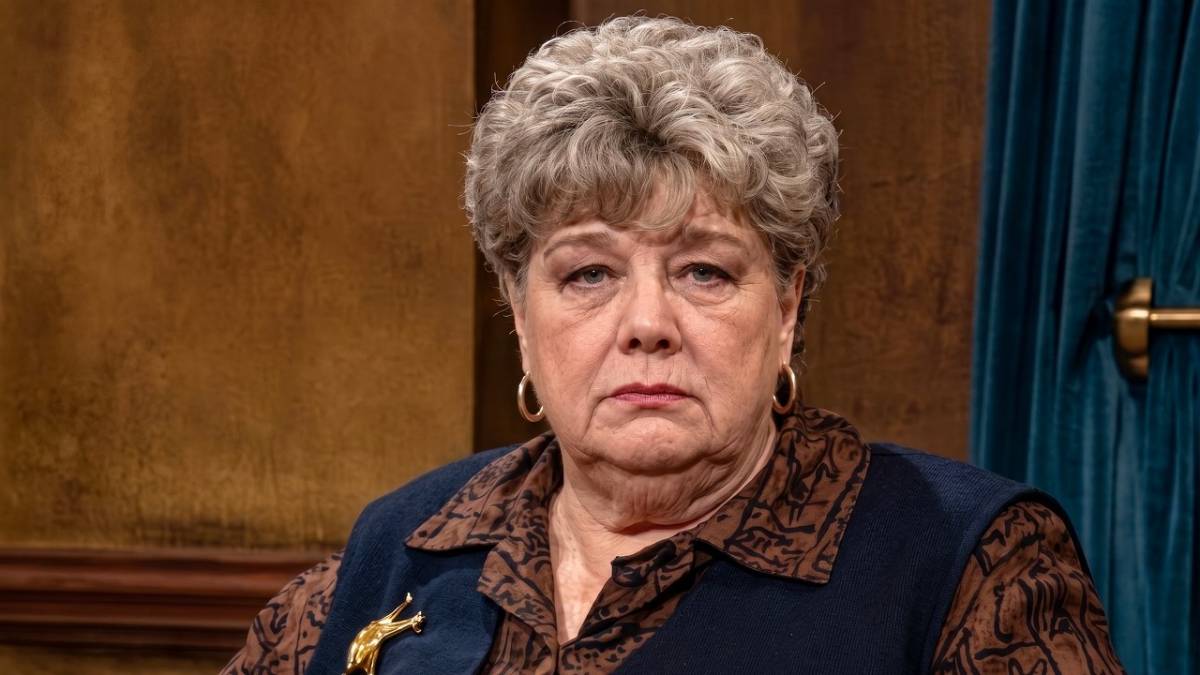
The world moved on, unaware that a stunning truth lay buried beneath the surface of a life lived in plain sight. For two decades after her passing, the secret she guarded with such fierce privacy remained hidden, locked away in the quiet spaces between her public triumphs and private struggles. But secrets, no matter how carefully kept, always find their way into the light. Today, for the first time, we finally know what Shelley Winters was hiding, and once you hear it, you will never look at her story the same way again.
 Shelley Winters was born on August 18th, 1920 in St. Louis, born as Shirley Schrift into a family shaped by immigrant struggle and quiet ambition. Her father, a tailor, and her mother, once a performer, carried echoes of a life left behind in Europe, stories of survival stitched into their everyday existence. Her childhood soon shifted to New York, where Brooklyn and Queens became the backdrop of her early years. It was a life balanced on the edge, not quite poverty, but never far from it.
Then came a moment that fractured everything. Her father’s conviction, after being accused of burning his own shop for insurance, cast a long shadow over the family. The whispers, the shame, the sudden loss of security, it all arrived too early. Winters would later suggest that this was when childhood quietly slipped away. In school, she found an escape. The stage became a refuge, where confusion and pain could be reshaped into something meaningful.
Hollywood, distant and glittering, felt like another universe, but also a possibility. The path there was anything but smooth. She worked wherever she could, shops, modeling gigs, small performances, each step modest, yet slowly pulling her closer to the life she imagined beyond the limits of her beginnings. A fleeting moment of hope arrived when Gone with the Wind launched its nationwide search for Scarlett O’Hara. Among thousands, Shelley Winters stepped forward, still Shirley Schrift, then unknown, unpolished, and carrying quiet ambition.
The role slipped past her, but something more lasting remained. George Cukor offered a simple but defining suggestion. If she truly wanted this life, she needed to study it seriously. It wasn’t an opportunity, but it was direction, and that was enough. She returned to New York with renewed purpose, immersing herself in training at the New School and later the Actors Studio, where emotion was not performed, but lived. Slowly, the girl shaped by hardship began to transform into an actress capable of carrying those truths onto the stage.
Her first steps into that world were modest. A short-lived Broadway appearance in The Night Before Christmas in 1941 faded quickly, but standing under those lights meant something irreversible. She had arrived, if only briefly. Then came Rosalinda in 1942, a long-running operetta that demanded endurance. Night after night, she learned the quiet discipline of repetition, the way a character breathes, moves, and survives across performances. There was no sudden rise, no instant recognition, just the slow, steady shaping of craft.
And somewhere within that rhythm, Hollywood stopped feeling like a distant dream and began, quietly, to feel possible. In 1943, Shelley Winters quietly stepped before a film camera for the first time in There’s Something About a Soldier. The role was so small her name didn’t even appear, yet it marked a shift from the open space of theater to the intimate, unforgiving lens of cinema. What followed were years of near-invisible labor. Films like What a Woman, Escape in the Fog, and Tonight and Every Night gave her only fleeting moments on screen, faces that appeared, spoke briefly, and vanished before audiences could remember them.
Still, she returned each day, learning patience in long studio hours and restraint in performance. In Hollywood’s rigid system, it was possible to work constantly and remain unseen, and for a time, that was her reality. Gradually, her presence grew familiar behind the scenes. Studios noticed her look, shaping her into the image of a blonde bombshell, a role far simpler than the life she had lived. Then came a quiet turning point in A Double Life. Cast as an ordinary waitress opposite Ronald Colman, she abandoned glamour for something more fragile and real.

Her performance was understated, no dramatic flourishes, just the subtle weight of a life that felt painfully authentic. That simplicity made her character’s fate all the more haunting. When the film was released, it drew widespread attention, and while Colman earned the highest honors, critics began to notice her, an actress who, in only a few scenes, left a lasting impression. It was the first time her presence lingered beyond the frame. After that, everything shifted. A long-term contract followed, and the industry began to see what had long been forming beneath the surface.
The years of obscurity had not been wasted, they had prepared her, and at last, Shelley Winters was no longer just passing through the story. By the late 1940s, Shelley Winters began stepping into larger productions, no longer just a passing presence, but a name slowly gaining weight in Hollywood. Films like Red River and Cry of the City placed her alongside established stars, where even in supporting roles, she brought a grounded realism that cut through the polished surfaces of studio storytelling. In The Great Gatsby, she played Myrtle Wilson, a woman reaching toward a life that was never truly hers, while Winchester 73 revealed a harder, more seasoned edge, far removed from the glamorous image studios had once assigned to her.
The true shift came with A Place in the Sun. As Alice Tripp, a factory worker clinging to love and stability, Winters delivered something painfully human, fragile, anxious, and tragically real. Her performance earned an Academy Award nomination, and for the first time, forced Hollywood to look beyond her appearance. Yet the industry remained hesitant. Despite the breakthrough, she was often pushed back into familiar roles, shaped more by image than depth. Rather than accept that limitation, she turned inward, returning to the Actors Studio, where method acting demanded emotional honesty over surface appeal.
There, away from cameras, she rebuilt herself, digging into discomfort, refining silence, and learning to let vulnerability speak louder than performance. That transformation became visible on screen in The Night of the Hunter. As Willa Harper, she portrayed a woman slowly unraveling under quiet terror, her fear expressed not through dramatic outburst, but through hesitation, lowered eyes, and fading certainty. It was a performance shaped by restraint, making her fate feel all the more inevitable. In A Hatful of Rain, Celia Pope brought a different kind of tragedy, a woman holding her family together while watching it quietly collapse under addiction.
The performance, subdued and deeply internal, earned her another Oscar nomination and confirmed that her strength lay not in spectacle, but in truth. Then came the defining moment. In The Diary of Anne Frank, Winters portrayed Mrs. Van Daan not as a symbol, but as a flawed, anxious human being, irritable, frightened, and painfully real. It was a role stripped of vanity, driven by tension and survival. Her performance won the Academy Award, but what followed revealed something deeper. She donated the Oscar to the Anne Frank House, as if acknowledging that the story belonged to history, not to her.
By the end of the 1950s, the transformation was complete. The woman once framed as a Hollywood stereotype had reshaped herself into something far more enduring, an actress unafraid of discomfort, drawn to characters marked by fear, longing, and contradiction. And in those imperfections, she found a kind of truth that made it impossible for her to forget. Another defining chapter arrived in 1965 with A Patch of Blue, where Shelley Winters portrayed Rosan Darcy, a woman hardened by poverty, addiction, and disappointment. It was one of her harshest roles, stripped of warmth and comfort.

Yet beneath the bitterness lay something deeply human, a life worn down by years of struggle. The performance refused to soften reality, and that honesty earned her a second Academy Award, confirming her gift for bringing difficult, imperfect characters to life. By now, a pattern had emerged. From A Place in the Sun to The Diary of Anne Frank and beyond, Winters gravitated toward roles shaped by tension and contradiction, women not designed to be liked, but impossible to ignore. In The Poseidon Adventure, she appeared as Belle Rosen, an ordinary passenger caught in catastrophe.
Amid chaos, her character’s final act, sacrificing herself to help others escape, carried a quiet emotional weight. The film’s success brought her another Oscar nomination, a reminder that even later in her career, she could still command attention in unexpected ways. As Hollywood changed, Winters gradually moved toward television, where she continued to portray strong, eccentric figures with the same grounded intensity. Away from the screen, she turned inward, writing memoirs like Shelley, also known as Shirley and Shelley the Second. In them, she revealed a voice that was candid, sometimes sharp, and unafraid to expose the illusions of the industry she had spent decades navigating.
These reflections painted a portrait not of a polished star, but of a woman who had endured, adapted, and observed. Even as her appearances became less frequent, her presence never faded. When she stepped into a scene, there remained something unmistakable, an actress shaped by experience, carrying both the weight of her past and the truth she had learned to bring to every role. Long before fame settled around her, Shelley Winters entered her first marriage in 1942, marrying writer Paul Meyer while still struggling to find her footing in New York. Life then was restless and uncertain, days spent working to survive, nights chasing auditions and rehearsals that offered more hope than promise.
It was a union formed in motion before either of them had truly arrived anywhere. As Shelley’s ambitions pulled her closer to the stage, and eventually toward Hollywood, the distance between them quietly widened until the marriage dissolved almost as quietly as it had begun. When she reached Hollywood, her personal life shifted into a very different world. Relationships no longer grew out of neighborhood familiarity, but out of a dazzling, unpredictable industry. She moved among figures like Errol Flynn, Marlon Brando, and Clark Gable, connections that existed somewhere between rumor, memory, and fleeting reality.
In that environment, intimacy often blurred with image, and beginnings rarely promised permanence. Her most significant marriage came in the early 1950s, when she met Vittorio Gassman during the making of Mambo. They married in 1952, two actors bound by the same profession, yet pulled by different worlds. A year later, their daughter Vittoria was born, offering a brief moment where life seemed to gather into something steadier. But even that stability was fragile. His work in Europe and hers in America kept them apart more often than together. Their lives divided by distance and schedules that refused to align.
By 1954, the marriage had ended, leaving behind a child who would grow between cultures and a relationship shaped more by separation than shared time. Another attempt at permanence followed in 1957, when Shelley married Anthony Franciosa. He was rising quickly, intense and driven, while she carried the weight of years already lived in the industry. Their lives were filled with work, expectation, and the constant pressure of being seen. It didn’t take long for that strain to seep into their private world. By 1960, that marriage, too, had come apart. What followed were more relationships, each beginning with its own quiet hope, yet none lasting long enough to take root.

Her personal life, like Hollywood itself, seemed to move in cycles, bright beginnings, shifting loyalties, and endings that arrived almost without warning. Beneath it all lingered a sense that stability was always just out of reach, as if the same restless energy that drove her career had also shaped the fragile rhythm of her private life. Amid the many relationships that drifted in and out of her life, Shelley Winters held on to one bond that never fractured, her connection with her daughter, Vittoria Gassman. Vittoria grew up between continents, shaped by her mother’s restless career and the spaces in between.
Though film sets and constant travel often kept them apart, Shelley tried, in her own way, to remain present. As the years passed, Vittoria built a life of her own, yet their relationship endured, quiet, steady, untouched by the shifting rhythms of Hollywood. In many ways, it became the closest thing Shelley had to something lasting. As time moved on, the pace of her life began to slow. The woman who had once crossed studios and cities now lived more quietly in Beverly Hills, her world gradually narrowing with age and fragile health. The memories, however, remained vast, decades of roles, faces, and fleeting moments that had defined her journey.
In October 2005, a sudden heart attack changed everything. From that point forward, her strength steadily declined. The months that followed were marked by hospital stays and careful monitoring, as those close to her watched her condition weaken. Then, in an almost surreal final gesture, something unexpected happened. Just hours before the end, the man who had been by her side for years, Jerry De Ford, quietly married her at her hospital bedside. There were no celebrations, no audience, only a simple act carried out in the shadow of goodbye. On January 14th, 2006, Shelley Winters passed away at the age of 85.
With her, a long chapter of Hollywood history came to a close, a life that had stretched across eras, from the rigid studio system to a changing, uncertain industry. In the years since, her legacy has been remembered not just through awards like The Diary of Anne Frank and A Patch of Blue, but through something more enduring. She moved beyond the image Hollywood once gave her, choosing instead to inhabit characters marked by flaws, tension, and truth. These were not idealized women. They were complicated, sometimes harsh, often wounded, yet unmistakably real.
Perhaps that is why her performances still linger. Shelley Winters never seemed to disappear completely into her roles. Instead, she carried pieces of herself into every character, fragments of experience, struggle, and quiet resilience, so that behind each face on screen, there was always the sense of a real life still echoing beneath the story. And now, two decades after her death, that secret has finally emerged. What she hid for so many years was not a scandal or a crime, but something far more profound. It was the truth of her own survival, the weight of a childhood shattered by her father’s conviction, the shame of poverty, and the relentless drive to escape a past that threatened to define her.
She kept this hidden because she feared it would diminish her, that the world would see her not as a star, but as a girl from the margins who never quite belonged. Yet in hiding it, she became something greater. She became a vessel for the stories of others, for the women she played who carried their own hidden burdens. The secret she guarded was not a single event, but a lifetime of quiet endurance, a refusal to let her origins dictate her destiny. Today, as we finally understand what she concealed, we see her not as a figure of mystery, but as a woman of extraordinary strength.
The world has moved on, but now it knows. Shelley Winters lived among us, smiled at us, and carried her days like anyone else. But behind closed doors, she was guarding something extraordinary, something so deeply personal that not even the closest people ever suspected. For two decades after her passing, the stunning truth remained buried. But secrets, no matter how well kept, always find a way into the light. And now, for the first time, we know what she was hiding. And once you hear it, you will never look at her story the same way again.