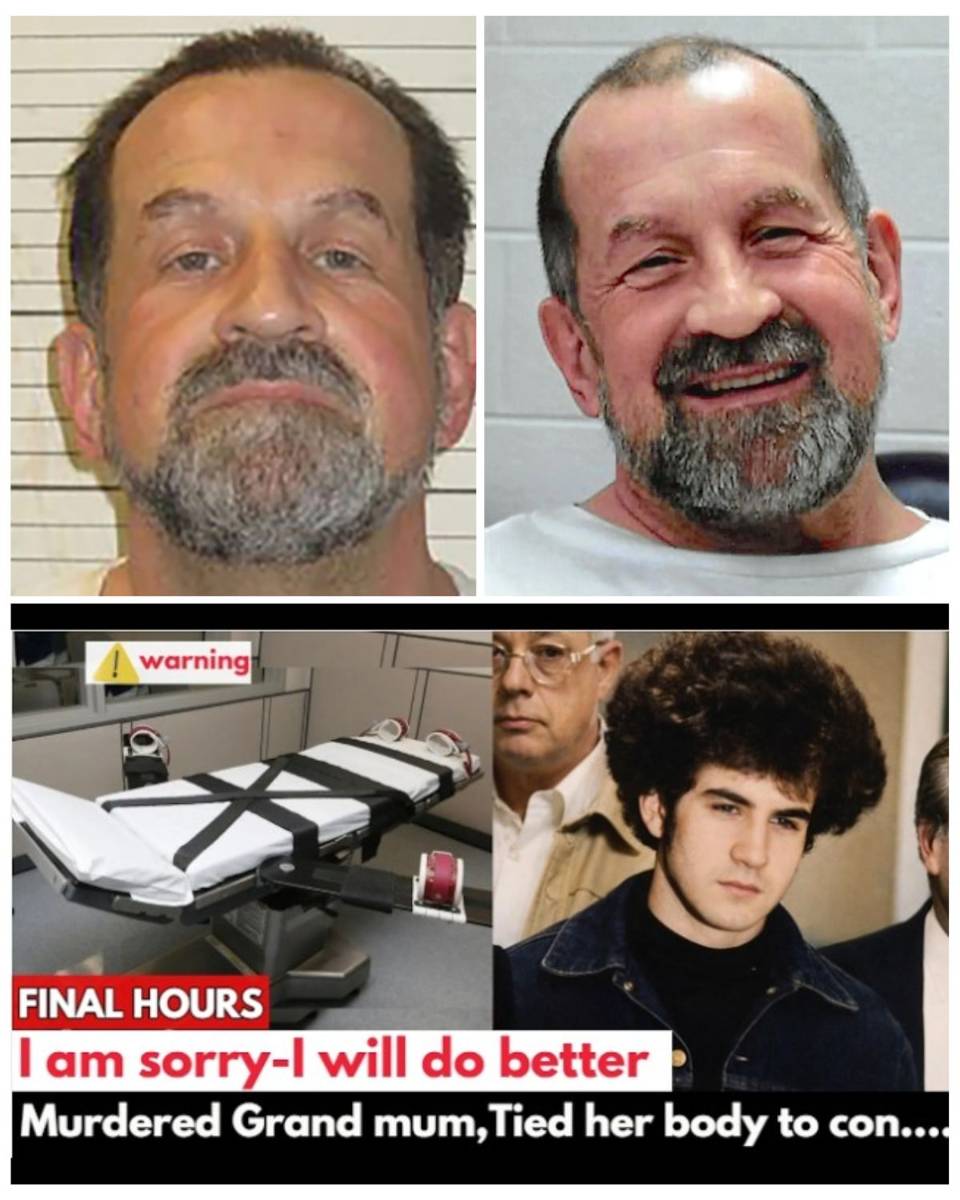
NASHVILLE, Tennessee — A man who spent more than three decades on death row for murdering his grandmother and three other people, including a fellow inmate, was executed Thursday night in the electric chair, becoming the most recent person in the United States to die by that method.
 Nicholas Todd Sutton, 58, was pronounced dead at 8:26 p.m. Central time at the Riverbend Maximum Security Institution in Nashville. He had been sentenced to death for the 1985 killing of fellow inmate Carl Eastep at the Morgan County Regional Correctional Facility, a crime that added a death sentence to the three life terms he was already serving for three murders committed in 1979.
The execution came after a remarkable clemency campaign that saw seven correctional officers, five of the original jurors who sentenced him to death, and even the eldest daughter of the man he killed in prison plead with Governor Bill Lee to spare his life. The governor denied the request.
Sutton’s final words were a prepared statement in which he thanked his wife, Reeba, and his family, and urged witnesses not to give up on the power of Jesus. He said Jesus had fixed him and that he was grateful to be a servant of God. He did not mention his victims by name.
The execution chamber at Riverbend was a clinical room with the electric chair at its center. Sutton was escorted in wearing yellow scrubs, the standard attire for death watch inmates. He was calm, making eye contact with media witnesses through the glass partition. His spiritual adviser administered a final communion before the execution protocol began.

Prison officials dowsed Sutton with saline solution to facilitate electrical conductivity. A shroud was draped over his face. At 7:18 p.m., the first jolt of electricity hit, causing his body to jerk backward against the chair. A second jolt followed. Six minutes later, prison officials lowered the blinds. Two minutes after that, he was declared dead.
Sutton’s path to the electric chair began in Morristown, Tennessee, where he was born on July 15, 1961. His mother abandoned him before his first birthday. His father, Pete Sutton, suffered from severe mental illness and was frequently institutionalized or jailed. Pete introduced his son to drugs by the time Nicholas was 12, and the two would get high together. In one incident, Pete took his own son and his mother hostage at gunpoint during a standoff with police.
Pete Sutton ended his own life in 1976, leaving Nicholas, then 15, without any parental figure. The teenager was already addicted to cocaine, prone to fighting, and struggling in school. He dropped out in the 11th grade but earned his GED in 1978. He enlisted in the Navy but received an honorable discharge after failing to adapt to military life.
Dorothy Virginia Sutton, Nicholas’s grandmother, took him in. She was a retired elementary school teacher, a widow, and a woman who believed love and stability could fix what was broken. She gave him a roof, regular meals, spending money, and a pickup truck. He sold the truck. He sold land she had given him. Every gift was converted to cash, then to cocaine.

In the summer of 1979, a dispute arose between Sutton and his friend John Michael Large, 19, over money from a cocaine deal. Sutton lured Large to his aunt’s remote farm property near Mount Sterling, North Carolina. There, he struck Large in the head with a blunt instrument, killing him. A piece of plywood was found lodged in Large’s mouth. Sutton buried the body in a shallow grave and returned to Tennessee as if nothing had happened.
Large’s family reported him missing. His father asked Dorothy Sutton if her grandson knew anything. Nicholas said he did not know. The body remained undiscovered for months.
Around the same time, Sutton killed Charles Pomeroy Alman III, a 46-year-old Knoxville contractor. Sutton later claimed Alman was involved in the same drug deal that led to Large’s death. He shot Alman, wrapped the body in bags, weighted it with cinder blocks, and dumped it in an old rock quarry near Newport, Tennessee. Alman’s gold Jaguar was found abandoned in front of a Holiday Inn. His family was left with no answers.
On December 22, 1979, Sutton argued with his grandmother over money. She refused to give him more. He picked up a piece of firewood and struck her in the back of the head. She collapsed but was still alive. He wrapped her in a blanket and trash bags, chained her to a 20-pound cinder block, and drove to the Hail Bridge over the Nolichucky River. He dropped her into the icy water. She drowned.

On Christmas Eve, Sutton showed up at the family’s holiday gathering carrying the wrapped gifts his grandmother had prepared. He had scratches on his face. He told his aunts she had left with an unknown man. They did not believe him. On Christmas Day, he walked into the Morristown Police Department and reported her missing.
Detectives found blood on the carpets, walls, and floors of Dorothy’s home. Under questioning, Sutton first claimed he found her dead and panicked. He later said Charles Alman had killed her and he shot Alman in self-defense. Investigators did not believe him. On December 30, 1979, divers recovered Dorothy’s body from the river. The autopsy showed she had been struck in the head but died from drowning.
Sutton was charged with her murder. While in custody, he began confessing to other crimes. He led investigators to John Large’s grave in North Carolina. He told them about Charles Alman’s body in the quarry. He also claimed he had killed two more people, a teenager from Alcoa and a drug buyer from Atlanta. He led investigators on extensive searches. They found nothing. The additional confessions were fabrications.
In April 1980, Sutton was convicted of first-degree murder for killing his grandmother and sentenced to life in prison. He pleaded guilty to killing Large and Alman in exchange for the death penalty being taken off the table, receiving two additional life sentences. At 19, he was a convicted triple killer with no realistic hope of release.
Sutton was sent to Brushy Mountain State Penitentiary, then transferred to the Morgan County Regional Correctional Complex in Wartburg. He continued using and dealing drugs. There, he crossed paths with Carl Isaac Eastep, a 44-year-old inmate serving a life sentence for assaulting his 9-year-old stepdaughter. Eastep was known as a marijuana dealer inside the prison. Sutton was one of his customers.
In early January 1985, a dispute arose over bad marijuana. Eastep refused to refund the money. He threatened to kill Sutton. Sutton decided to strike first. He recruited three other inmates, Charles Arnold Freeman, 23, Thomas Street, 33, and David Wesley Stuffreet, 22. They armed themselves with homemade knives and planned the attack for the gap between guard shifts, a 30-minute window when no officer was present in Guild 5.

On the morning of January 15, 1985, Sutton, Street, and Freeman pulled on toboggans and sunglasses, crossed from Guild 6 into Guild 5, and entered Eastep’s cell. Other inmates heard Eastep scream for help. Nobody came. By the time the next shift of correctional officers arrived, Eastep had been struck 38 times. Nine wounds reached his lungs, his vena cava, and his carotid artery. Two homemade knives lay on the bunk beside him. A third knife, which Eastep had kept for his own protection, was hidden under a lamp.
Sutton and Street washed their hands, removed their disguises, and placed their clothes in the laundry. Sutton was heard boasting afterward.
In March 1986, the case went to trial. Freeman was acquitted. Street was convicted of first-degree murder and sentenced to life. He was eventually released on parole. Sutton, with three prior murder convictions on his record, was sentenced to death. He was transferred to death row at Riverbend Maximum Security Institution. He was 24 years old.
What happened next defied expectations. In the summer of 1985, before Sutton’s trial, the Tennessee State Prison erupted in a riot. Buildings were set ablaze. Armed inmates roamed the facility. A young correctional officer named Tony Eaton found himself cornered by five inmates who intended to take him hostage. Sutton appeared and physically intervened, removing Eaton from the situation and escorting him to safety.
Eaton would later say he owed his life to Nicholas Sutton. When the Tennessee State Prison closed, Eaton was transferred to Riverbend, where Sutton was on death row. The guard and the inmate formed a bond that endured for decades. Sutton made only one request of Eaton, to be the best man at his wedding.
On death row, Sutton found stability for the first time in his life. The routine forced sobriety. The fog of cocaine addiction lifted. He enrolled in a pen pal program and began corresponding with a woman named Reeba. She introduced him to Christianity. He began reading the Bible, attending services, and changing in a quiet, sustained way that those around him noticed over months and years.
In 1994, Sutton and Reeba were married inside the visitation gallery of the death row unit at Riverbend. Tony Eaton stood beside him as best man. Sutton became a dedicated husband, stepfather, and step-grandfather. He wrote letters to Reeba’s family. He formed bonds with people he would never be able to visit or hold.
Sutton became the maintenance man at Riverbend, trusted with hammers, screwdrivers, and wrenches for more than 20 years. He studied conflict resolution and mediation techniques. When tensions flared between inmates, he stepped in and diffused situations before they escalated. Dr. Graham Reside, a professor of ethics at Vanderbilt Divinity School, ran a combined class at Riverbend that included divinity students and death row inmates. Sutton became one of the most engaged participants.
Correctional officers began speaking about Sutton in terms almost unheard of in the prison system. One wrote that his efforts at self-improvement and willingness to embrace change were an inspiration. Another described him as an honest, kind, and trustworthy man who had used his time in prison to better himself. A third said flatly that Sutton was not the same man who had committed those crimes.
Sutton’s legal team fought to overturn his death sentence. The Tennessee Supreme Court affirmed the conviction in 1988. The U.S. Supreme Court declined to review it in 1990. His attorneys pursued post-conviction relief, arguing that his trial lawyers had failed to present critical mitigating evidence, his abusive father, his mother’s abandonment, his introduction to drugs at 12, and a neuropsychological evaluation showing severe developmental impairments caused by trauma. They also raised the issue that Sutton had been brought into the courtroom in shackles and handcuffs in full view of the jury.
Every court denied relief. A dissenting federal judge called Sutton’s childhood horrific but was outvoted. An execution date was set for 2015 but stayed over issues with the state’s execution protocol. A new date was set for February 20, 2020.
On January 14, 2020, attorney Kevin Sharp, a former federal district court judge, filed a clemency petition with Governor Bill Lee. The petition did not ask for release or a pardon. It asked only that the death sentence be commuted to life without parole. The support behind it was extraordinary.
Seven correctional officers asked the governor to spare his life. Five of the original jurors who had sentenced him to death asked the governor to spare his life. Carl Eastep’s eldest daughter, Rosemary Hall, asked the governor to spare his life. Charles Alman’s great-niece asked the governor to spare his life. The mother of exonerated death row inmate Paul House asked the governor to spare his life. A Vanderbilt Divinity professor asked the governor to spare his life. A former correction commissioner asked the governor to spare his life.
Not everyone agreed. Amy Large Cook, John Large’s sister, wanted the execution carried out. Sutton’s uncle Thomas Davis had long since cut all ties.
On February 19, 2020, one day before the scheduled execution, Governor Bill Lee released his statement. After careful consideration of Nicholas Sutton’s request for clemency and a thorough review of the case, he wrote, he was upholding the sentence of the state of Tennessee and would not be intervening.
The denial was a blow to Sutton’s supporters. Kevin Sharp expressed disappointment. Tony Eaton was devastated. Joyce House, Paul’s mother, was heartbroken. But the legal team had two final motions pending before the United States Supreme Court, a request for a stay of execution and a challenge to the constitutionality of Sutton’s trial. On February 20, 2020, as the execution clock ticked down, the court released its decisions. Both motions were denied. There would be no stay. There would be no review.
Three days before the execution, Sutton was moved to death watch. He turned in his white death row uniform and was issued yellow scrubs. His movements were restricted. He was only allowed to speak to visitors through a glass pane. The casual interaction that had defined his decades on death row was over.
Because he had been sentenced to death before 1999, Tennessee law allowed Sutton to select his method of execution. The options were lethal injection or the electric chair. Four of the last five inmates executed in Tennessee had chosen the electric chair, arguing that the state’s lethal injection protocol, which used the sedative midazolam, resulted in a prolonged and agonizing death. Sutton made the same choice.
He selected his final meal, fried pork chops, mashed potatoes with gravy, and peach pie with vanilla ice cream. The meal was served on February 19. His spiritual adviser visited and served communion, Welch’s grape juice and a wafer. Sutton prayed. He spoke with his wife Reeba by phone. He called his friend from Morristown, a man named Webb, who had known him as a teenager and had signed the clemency petition. In their final conversations, Sutton talked about God and spirituality. He told Webb that God was real.
Sutton made one request of his family. Do not come to the execution. He did not want them to watch him die. He did not want their last image of him to be in the electric chair. They honored his wish. None of Sutton’s family members attended. None of Eastep’s family members attended either. But Amy Large Cook was at the prison. She had come to see the execution of the man who had killed her brother John 41 years earlier. She had waited a long time for this night.
The execution was scheduled for 7 p.m. Central time. By evening, the prison was surrounded by media, protesters, and witnesses. Inside, Sutton was escorted to the execution chamber. The curtain to the witness chamber opened. On the other side of the glass, media witnesses looked in. Sutton was already seated in the electric chair. He was looking forward with a steady, composed expression. He made eye contact through the glass. His face showed no panic, no tears, no visible distress. He was calm.
He was asked if he had any final words. He did. He thanked his wife Reeba first. Then he thanked his family and his many friends for their love and support as they had tried so very hard to save his life. He told the witnesses not to give up on the power of Jesus to take impossible situations and correct them. He said Jesus had fixed him. He said he was grateful to be a servant of God and that he was looking forward to being in God’s presence. He closed simply, I thank you.
He said nothing about his victims. He did not mention Dorothy Sutton, John Large, Charles Alman, or Carl Eastep by name. He did not apologize directly in his spoken statement, though his attorneys had emphasized his remorse throughout the legal proceedings.
After his statement, his spiritual adviser administered a final communion. Then prison officials began the execution protocol. Sutton was dowsed with saline solution. A shroud was draped over his face. At 7:18 p.m., the first jolt of electricity hit. His body jerked backward against the chair, his fingers tightened on the armrests. Then came the second jolt. The media witnesses watched through the glass for any signs of life. There were none.
Six minutes later, prison officials lowered the blinds. Two minutes after that, at 7:26 p.m. Central time, Nicholas Todd Sutton was declared dead. He was 58 years old, the same age his grandmother had been when he killed her 41 years earlier.
He was the seventh person executed by the state of Tennessee since it had resumed capital punishment in August 2018. He was the 139th person put to death in the state since 1916. And he was the most recent person in the United States to die in the electric chair.