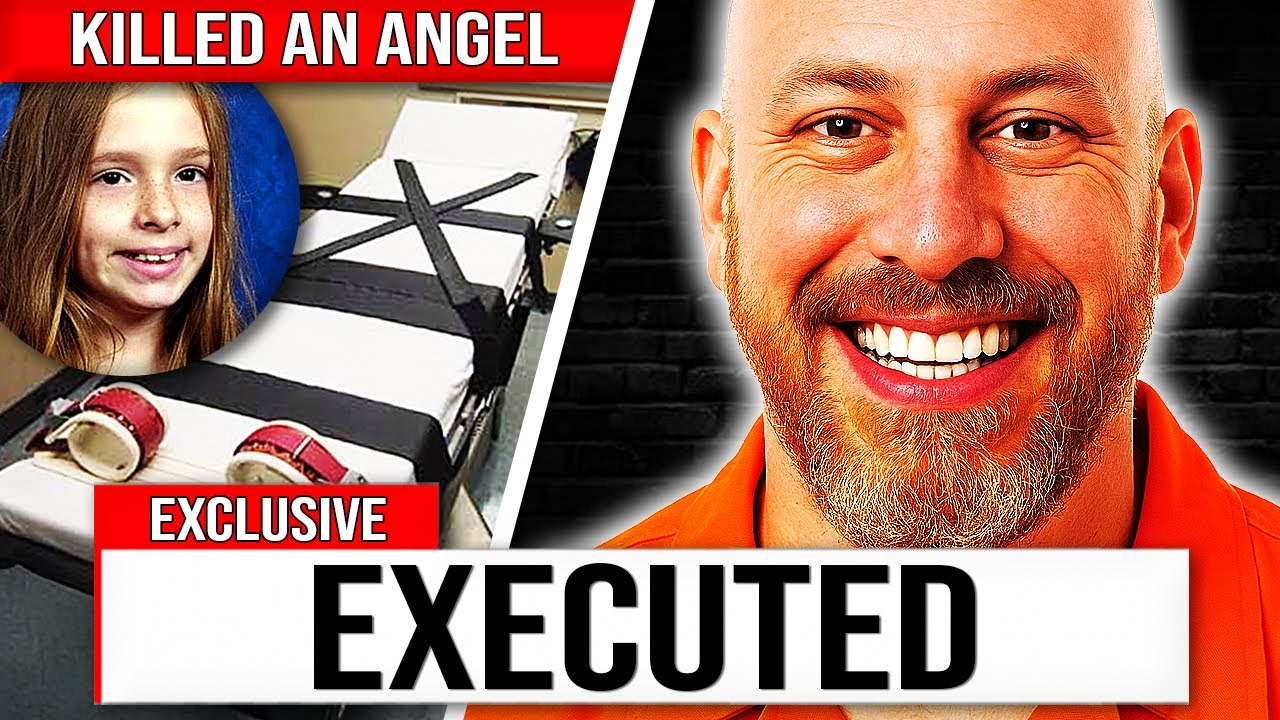
The final breaths of Christopher Leroy Collings came at 6:10 p.m. on December 3, 2024, inside a Missouri execution chamber, where a gurney and a needle ended a life that had stolen another 17 years earlier. For the family of Rowan Ford, a nine-year-old girl who vanished from her bed in Stella, Missouri, on the night of November 3, 2007, the moment was a hollow victory, a legal closure that could never replace the light they lost. Collings, 49, had spent 12 years on death row after a jury deliberated for just 48 minutes to condemn him for what they called an outrageously and wantonly vile murder. His final meal was a bacon cheeseburger, tater tots, breaded mushrooms, and a chef salad, a last taste of freedom before he was strapped down and injected with lethal drugs. In a written statement, he offered a tepid apology to anyone he had hurt, saying, Right or wrong, I accept this situation for what it is. But for Rowan’s older sister, Ariani, those words rang hollow, as she told reporters that lethal injection was too kind for a man who took someone who lit up every room.
The crime that led to Collings’ execution began on a quiet autumn night when Rowan Ford was supposed to be safe in her bed. Her mother, Colleen Mason, had left for a late shift at work around 8:30 p.m., entrusting her daughter to her husband, David Wesley Spears. But Spears was not alone that evening. He was drinking heavily and shooting pool with two friends, Christopher Collings and Nathan Mahorin, in the family home. The trio consumed alcohol with reckless abandon, and at some point, Collings decided to return to his own trailer in nearby Weeden to smoke a large hand-rolled joint he called a hog leg. He convinced Spears and Mahorin to join him, leaving Rowan alone in the house, a decision that would prove catastrophic. They made multiple trips to buy more alcohol, and by the time the clock neared 11:30 p.m., Mahorin and Spears finally left the trailer, with Mahorin driving Spears home along winding back roads due to his intoxication.
But Collings did not stay behind. A dark thought seized his alcohol-clouded mind. He calculated that if he left shortly after the others, he could beat them back to Spears’ house, having consumed more than five six-packs of Smirnoff Ice and admitting later that he was really, really messed up. He drove the most direct route, and when he stepped inside the house, it was eerily quiet. He moved from room to room as if he owned the place, even pausing to use the bathroom, his mind fixed on something sinister. He walked into Rowan’s room, where she lay asleep, small and defenseless, unaware of the predator now standing over her. Without a word, he scooped her up, carried her to his truck, and drove back to his trailer, where he laid her on his bed. She was still asleep, her body limp, but the worst was yet to come.
Rowan woke up in the middle of the night to find herself in a stranger’s bed, and the second she realized what was happening, she fought back. Collings did not stop. He later claimed he meant to take her home after he was done, a hollow justification he told himself as he led her toward the door. The room was dark, and he stayed quiet, careful to keep her facing away. But a strip of moonlight broke through the trees and lit up his face. When Rowan turned and saw him, she froze. She knew that man. Collings had been part of the family’s life for years, a close friend of her stepfather, David Spears, who had even lived in their basement for months. She had called him Uncle Chris, and he had helped her with homework. But in that moment, everything changed. Collings panicked, his eyes darting to a coil of cord in the back of his nearby pickup truck. His hands moved before his mind could stop them, slipping the loop over her head and pulling until she stopped moving.
After it was over, Collings realized there was no turning back. He placed Rowan’s body in the bed of his truck and drove to a cave on Fox Hollow Hill, where he dumped her into a sinkhole and tried to cover the top with sticks and debris. He returned home and burned her pants, underwear, the rope, and his own bloodstained clothes in a stove. He rolled up the mattress, stuffed it into a burn barrel with old carpet, and lit it on fire inside a barn, hoping no one would notice. Then he went to bed as if it were just another night. But when Colleen Mason returned from her overnight shift around 9 a.m. the next morning, the first thing she noticed was the silence. Rowan was not in her bed, and she was not anywhere in the house. She searched every room, calling her daughter’s name, but there was no answer. She woke David, who told her Rowan was staying with a friend, but he could not provide a name or address.

Colleen stepped outside and walked the neighborhood, scanning yards and driveways, but found nothing. She told David they needed to call the police, but he brushed her off, repeating that Rowan was at a friend’s house and refusing to let her use the phone. By the afternoon, with her gut screaming that something was wrong, Colleen contacted the sheriff’s office and reported Rowan missing. David, Nathan, and Chris were immediately questioned as the last people to have seen Rowan, but they all claimed to know nothing about her disappearance. By November 5, two days after the report, the case had grown too large for Newton County alone, and the FBI stepped in. While local deputies pressed David for answers, federal technicians took his pickup truck and another vehicle his mother said she had loaned him the night Rowan vanished. That same night, the FBI met with Collings and Colleen at her home, and Collings stuck to his original story, even offering to wear a wire to help the investigation.
Collings volunteered for a polygraph and a computer voice stress analysis, naming possible locations where David could have hidden Rowan. On November 7, he met with the FBI again, handing over a DNA swab and signing off on searches of his safe, property, and trailer. But when the topic turned back to Rowan, everything about him changed. He grew tense, emotional, and defensive, and when agents pushed further, he snapped, telling them if they were accusing him, the conversation was over. Six days in, David finally broke and told police exactly where to find Rowan. Her body was found at the bottom of a remote sinkhole called Fox Cave, nude from the waist down except for one sock, with rope marks around her neck and leaves and debris covering her. The scene spoke for itself. As soon as Collings heard that she had been found, he knew it was over. He told officers to meet him at Muny Bridge, and when they arrived, he held out his hands and asked to be cuffed.
Officer Clinton Clark told him that would not be necessary, but Collings insisted, saying, For what I’m about to tell you, you will. Sitting on the slope by the bridge, he broke down and confessed everything. He repeated the confession at the station on camera, admitting he had been balling like a baby all afternoon. But what stunned investigators was that they still believed David was the one behind Rowan’s disappearance. That changed fast when David flipped his story, claiming he had been there when Collings killed her and that he had led police to her body. Collings denied David’s involvement, insisting he acted alone, but the evidence told a different story. Search teams found rope, wire, burned debris, ashes, and even hair in Collings’ truck. The autopsy confirmed Rowan had been strangled, with an estimated 10 seconds of consciousness before she passed out and brain death within minutes. The report also showed severe trauma, bruising, and injuries from being thrown into the sinkhole.
The morning before Rowan’s funeral, teachers and children gathered in the cold, standing around a small hole in the earth where they planted a young pink dogwood tree, pink being Rowan’s favorite color. Beside it, they placed a concrete angel and a marker etched with the two dates that now defined her life: April 11, 1998, the day she was born, and November 9, 2007, the day she was found. A cluster of purple balloons were lifted into the gray sky, each carrying a note from her classmates, messages written in shaky handwriting and crayon strokes. Her teacher, Mr. Hol, told the court that he kept Rowan’s desk untouched for days because he could not face what clearing it out meant. Another teacher, Tammy Marshall, recalled the last time she saw her, just hours before everything happened. Rowan’s hair was badly tangled that morning, a common occurrence, and Tammy sat with her for half an hour, patiently brushing and untangling each knot, pulling the mess into a neat ponytail. A small act of care, but no one knew it would be the last.
After David was arrested for his involvement, Colleen immediately filed for divorce. I just couldn’t take anymore, she shared in court. The grief had pushed her into the hospital, and she was now under psychiatric care, trying to piece together a life that no longer felt whole. When Collings finally stood trial, he did not try to deny any of it, but that honesty did not make what he did any easier to hear. Jurors sat through his testimony about Rowan’s final moments, how she was groomed, betrayed, and murdered by a man she thought she could trust. In March 2012, it took them only 48 minutes to decide his fate. They called the murder outrageously and wantonly vile and sentenced him to death. At first, both Collings and David faced the same charges: one count of first-degree murder, one count of forcible rape, and one count of statutory rape. But as the year went on, the case against David began to shift.

On September 26, prosecutors made a quiet but pivotal move, dropping the murder charge against David. Instead, the prosecution and defense struck a plea deal. David would admit guilt, but not for killing Rowan. He pleaded guilty to endangering the welfare of a child and to helping cover up a crime. The state explained that further investigation had not turned up solid proof that David took part in the rape or murder, and while his actions were serious, they argued his role was far smaller than Collings’. The judge sentenced David to 11 years in prison, but because his time counted from the day of his arrest in 2007, he did not serve the full term. After just over seven years, he quietly walked out of prison in 2015, with no apology, no public statement, just freedom. For Collings, however, the case played out differently. He spent the next 12 years on death row, fighting the inevitable through appeals and legal motions, but the courts upheld his sentence.
In 2024, his time finally ran out. On December 3, when Rowan would have been 26 years old, Missouri carried out his execution by lethal injection. For his final meal, he chose a bacon cheeseburger, tater tots, breaded mushrooms, and a chef salad. Later that night, he was strapped to the gurney, and before the drugs were administered, he offered a written final statement. Right or wrong, I accept this situation for what it is, he wrote. To anyone that I have hurt in this life, I am sorry. I hope that you are able to get closure and move on. He continued, saying that regardless of which side of this situation you are on, you are in my prayers, and I hope to see you in heaven one day. But for her family, it was too little, too late. Rowan’s older sister, Ariani, said she felt justice was finally served, but not complete. He took someone who lit up every room, she said. Lethal injection was too kind for him.
The execution brought a legal end to a case that had haunted the small community of Stella, Missouri, for nearly two decades. Rowan’s disappearance and murder had shattered a family and exposed the dark underbelly of trust and betrayal. Collings’ final words, while apologetic, could not undo the horror of that November night, nor could they restore the life of a nine-year-old girl who had smiled with her whole face. The state of Missouri, in carrying out the death penalty, argued that justice demanded the ultimate price for a crime so heinous that it defied comprehension. But for those who loved Rowan, the execution was a bittersweet moment, a reminder that no punishment could ever bring her back. The pink dogwood tree planted in her memory continues to grow, a silent testament to a life cut short by a man who had once been called Uncle Chris.
As the news of Collings’ death spread, reactions poured in from across the state and beyond. Victim advocacy groups praised the execution as a necessary step toward closure, while death penalty opponents questioned the morality of state-sanctioned killing. The debate raged on social media and in living rooms, but in the Ford family home, there was only silence. Colleen Mason, who had spent years in psychiatric care, released a brief statement through her attorney, saying that she hoped Rowan could finally rest in peace. The case had taken a toll on everyone involved, from the investigators who sifted through the ashes of Collings’ burn barrel to the teachers who remembered Rowan’s tangled hair and bright smile. The community of Stella, a small town where everyone knew everyone, had never fully recovered from the shock of a child vanishing from her own bed.
The legal proceedings against David Spears had added another layer of complexity to the tragedy. His plea deal and early release had sparked outrage among those who believed he should have faced harsher punishment. But prosecutors maintained that the evidence against him was insufficient to prove his direct involvement in the murder, and his cooperation had been crucial in locating Rowan’s body. Spears, now a free man, had never publicly addressed the case, leaving many to wonder about his role that night. Collings, in his confessions, had consistently claimed that Spears was not involved, but the fact that Spears knew where to find the body raised questions that would never be fully answered. The case had become a cautionary tale about the dangers of alcohol, trust, and the fragility of childhood innocence.
In the years leading up to his execution, Collings had exhausted his appeals, with courts at every level rejecting his claims of ineffective counsel and procedural errors. His legal team had argued that his intoxication at the time of the crime should have mitigated his sentence, but the jury had seen it differently, citing the calculated nature of his actions. The execution itself was carried out without incident, with witnesses describing a quiet, clinical procedure that ended with Collings’ final breath. The Missouri Department of Corrections issued a brief statement confirming the time of death and thanking the staff involved for their professionalism. For the Ford family, the wait was over, but the healing had only just begun.
As the sun set on December 3, 2024, the pink dogwood tree in Stella stood as a silent sentinel, its branches bare in the winter cold. Rowan’s classmates, now adults, had long since moved on, but the memory of that morning when they released purple balloons into the gray sky remained etched in their minds. The concrete angel beside the tree bore the weight of a community’s grief, a reminder of a life that should have been filled with laughter and dreams. Christopher Leroy Collings was gone, but the scars he left behind would take generations to heal. In the end, justice had been served, but as Ariani Ford said, it was not complete. The only true justice would have been Rowan Ford, alive and well, lighting up every room she entered. Instead, her family was left with a grave and a tree, and the hollow echo of a final apology that came far too late.
Source: YouTube