A new and untested method of capital punishment has been used for the first time in United States history, marking a grim and controversial milestone in the nation’s death penalty debate. The state of Alabama executed convicted murderer Kenneth Eugene Smith, 58, by nitrogen hypoxia Thursday night at the William C. Holman Correctional Facility, proceeding after the U.S. Supreme Court denied a final appeal.
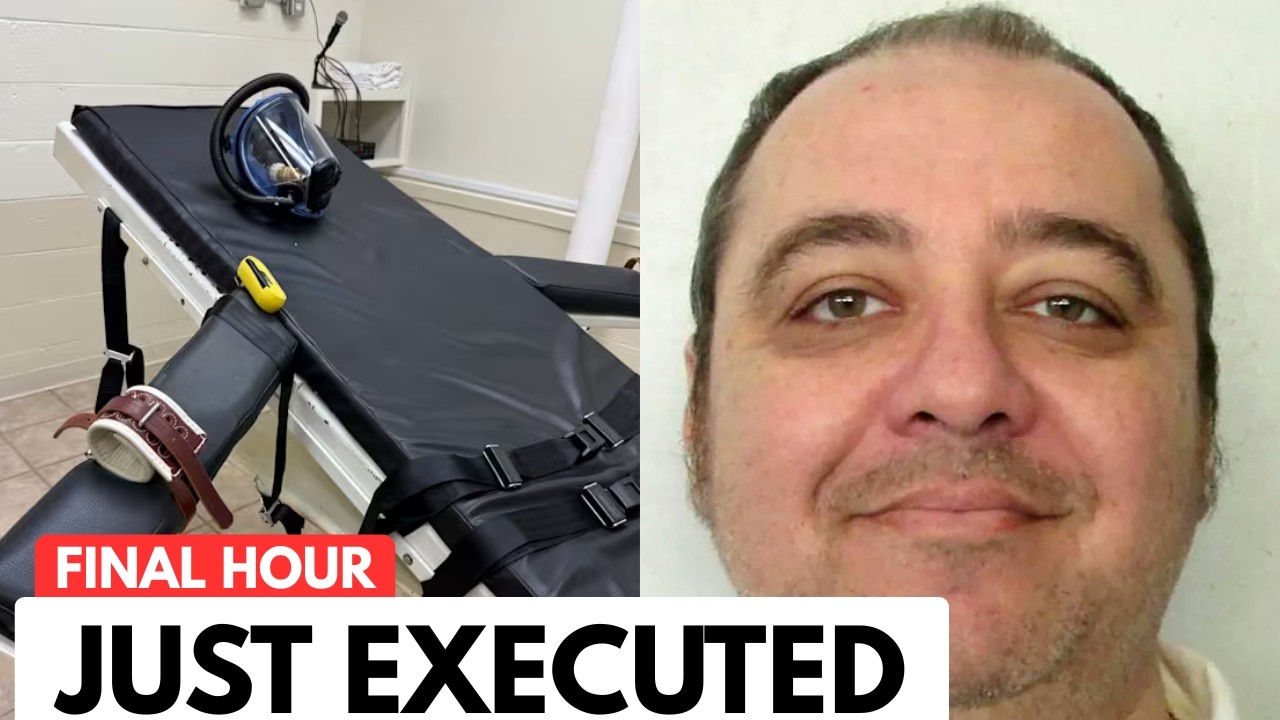
Smith was pronounced dead at 8:25 p.m. local time, but witness accounts describe a prolonged and violent struggle that lasted nearly half an hour, starkly contradicting state promises of a swift and painless death. The execution, carried out with a method critics equate to human experimentation, has ignited immediate international condemnation and promises to reshape the future of capital punishment in America.
The journey to this unprecedented moment began thirty-six years ago with a brutal crime in Sheffield, Alabama. In March 1988, Kenneth Smith and an accomplice, John Forrest Parker, were hired by Reverend Charles Sennett Sr. to kill his wife, Elizabeth. The pastor, mired in debt and infidelity, sought to collect on a life insurance policy.
Court records state Smith and Parker attacked Elizabeth Sennett, 45, in her home, beating and stabbing her. Investigators believe Reverend Sennett later administered a final, fatal wound before calling the police. Elizabeth Sennett died a week later. As investigators closed in, Reverend Sennett died by suicide. Physical evidence, including a stolen VCR found in Smith’s possession, directly linked him to the murder.
Smith’s path to the death chamber was legally complex. After a first conviction in 1989, a second trial in 1996 resulted in a jury voting 11-1 to recommend a life sentence. An Alabama judge, exercising a since-abolished power known as judicial override, imposed the death penalty instead. His co-conspirator, John Parker, was executed by lethal injection in 2010.
Alabama first attempted to execute Smith by lethal injection on November 17, 2022. The effort failed catastrophically. Executioners struggled for hours to establish intravenous access, ultimately calling off the procedure. Smith alleged he was left strapped to the execution gurney in agony and confusion for four hours, an experience that left him with lasting trauma.

As part of a subsequent settlement, the state agreed not to attempt another lethal injection. It offered Smith the untested alternative of nitrogen hypoxia, a method involving the administration of pure nitrogen to induce fatal oxygen deprivation. The state’s secretive protocol faced fierce legal and ethical challenges in the months that followed.
Medical experts and human rights organizations globally raised alarms. Smith’s legal team argued the method risked a torturous death, citing concerns about mask seal integrity and the potential for vomiting and prolonged suffering. The United Nations called for a halt, warning the execution could constitute torture under international law.
All appeals were exhausted. On the afternoon of January 25, Smith and his spiritual advisor issued a joint statement calling the impending execution a “moral apocalypse.” Elizabeth Sennett’s adult sons, however, told the media they believed it was time for justice to be served for their mother, whom they felt had been forgotten.
Smith spent his final hours with family, including his wife, Deanna. He consumed a last meal of steak, hash browns, and eggs. At 7:56 p.m., the execution commenced. A full-face mask was secured over his head. His muffled final words were, “Tonight, Alabama caused humanity to take a step backwards. I leave with love, peace, and light.”
What followed, according to multiple media witnesses, was not the swift loss of consciousness the state had guaranteed. At approximately 7:57 p.m., Smith’s body began to convulse violently against the restraints. His torso jerked, his fists clenched, and his legs shook rhythmically for several minutes.
He was seen gasping for air, his chest heaving repeatedly. Witnesses reported seeing fluid inside the clear mask. The intense physical struggle subsided into shallow breathing, which continued for many minutes before he was finally pronounced dead. The entire process lasted 29 minutes.

The reaction from authorities was split along predictable lines. Alabama Attorney General Steve Marshall declared, “justice has been served.” Elizabeth Sennett’s son, Michael, stated the family had forgiven those involved years ago but affirmed the execution brought closure. He noted Smith and Parker had been imprisoned longer than he had known his mother.
International bodies expressed horror. The U.N. High Commissioner for Human Rights stated the execution could amount to torture or other cruel, inhuman, or degrading treatment. Special Rapporteurs condemned it as a barbaric reminder of the death penalty’s nature. Advocacy groups demanded an immediate moratorium on the method.
Despite the controversy, Alabama has already signaled that this was not an isolated event. The state executed a second inmate, Alan Eugene Miller, by nitrogen hypoxia in September 2024. Other states, including Oklahoma and Mississippi, have authorized the method and are closely studying Alabama’s protocol, making Smith’s death a potential blueprint.
The legacy of this case is a tangle of undeniable crime and deeply questionable punishment. A woman was brutally murdered for money. A jury largely voted for mercy, but a judge imposed death. A failed execution caused profound suffering. Finally, the state pioneered a novel form of killing that resulted in a prolonged, violent death witnessed by the world.
Kenneth Smith’s final question hangs in the air, a challenge to the public conscience. When the pursuit of justice employs untested methods that cause observable distress and take nearly thirty minutes to achieve death, it forces a fundamental reckoning. The debate is no longer merely about guilt or innocence, but about the very methods a society is willing to endorse and the precedents it is willing to set in the name of justice. The world is now watching which direction America will step next.
Source: YouTube