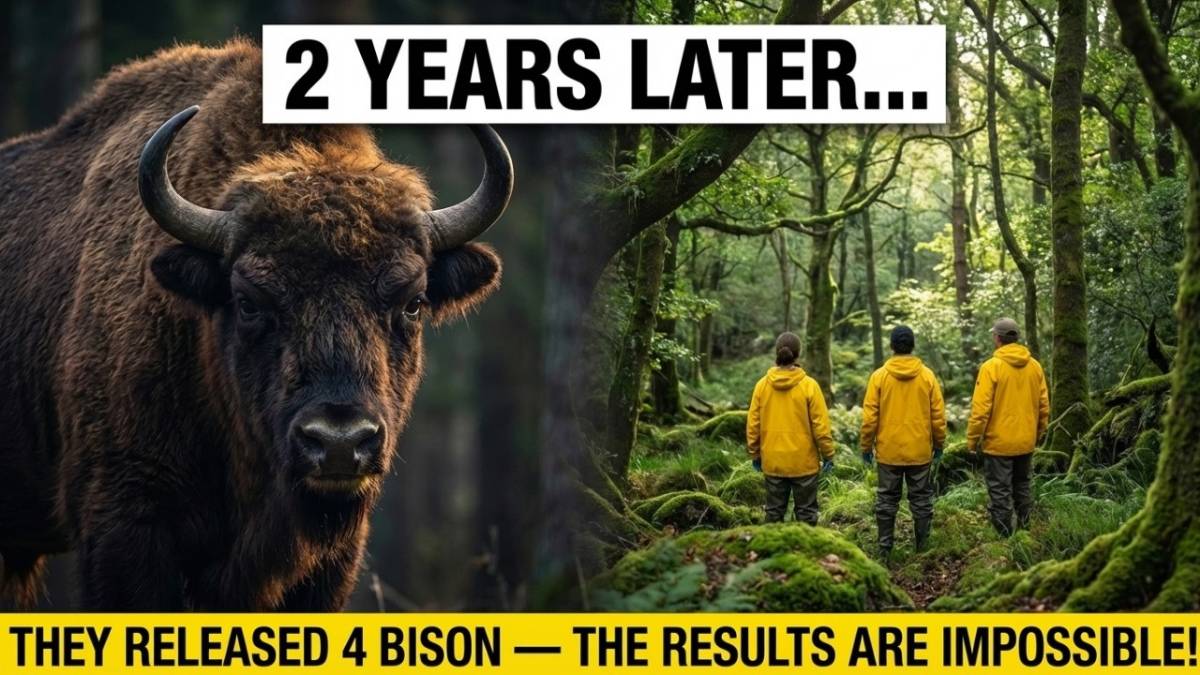
A quiet revolution is unfolding in an ancient English woodland, driven by four massive newcomers whose simple acts of destruction are bringing a dying ecosystem back to life. In July 2022, European bison, absent from Britain for six millennia, stepped into West Blean and Thornden Woods near Canterbury. Their immediate impact has rewritten the rulebook on conservation, challenging long-held beliefs about how to save nature.
 The project, led by the Wildwood Trust and Kent Wildlife Trust, introduced the bull and three females as living tools. Their mission was singular: to rescue a forest that was ecologically collapsing from within. Despite its lush appearance from a distance, the woodland suffered from a dense, closed canopy that blocked sunlight, creating a biological desert beneath the green facade.
For decades, conservationists battled this decline with chainsaws and manual labor. Teams cut back invasive rhododendron and thinned trees to let in light. These efforts provided temporary relief, but the canopy always regrew. The scale—over 1,300 acres—made perpetual human intervention financially and logistically impossible. The forest needed a self-sustaining solution.
The bison provided it instinctively. Within hours of release, they began stripping bark from oaks and ashes, a behavior that kills trees. To the untrained eye, this was vandalism. In ecological terms, it was the creation of vital “snags”—dead standing trees that host woodpeckers, beetles, and fungi. They also pushed over saplings, punching holes in the dark canopy.
 Their wallowing behavior, digging deep depressions in the soil, created patches of bare earth. These micro-habitats became instant hotspots for ground-nesting bees and rare plants. Perhaps most strikingly, the bison decimated stands of invasive rhododendron, trampling thickets that had resisted years of human effort. Light flooded the forest floor for the first time in generations.
The ecological response was rapid and profound. Dormant seeds germinated. Plants unseen for decades reappeared. Dung beetles colonized manure piles. Surveys documented a 60% increase in slow worm populations. Grass snake sightings quadrupled. Specialist fungi fruited from bison dung, spores having waited centuries for their return.
Just two months post-release, the herd’s matriarch gave birth to the first wild bison calf in Britain in thousands of years. The herd has since grown, amplifying their transformative impact. Aerial imagery now shows a mosaic of light and shadow, a complex habitat where uniform darkness once reigned.

This visible change has sparked intense debate. The bison’s work is messy. It leaves scarred trees, muddy wallows, and tangled deadfall. This clashes with the traditional British aesthetic of tidy, managed countryside. Some visitors perceive the landscape as damaged, not healed, forcing a fundamental question: What does a healthy forest actually look like?
The project confronts deeper philosophical tensions in conservation. It challenges whether the goal is to maintain static, human-curated landscapes or to restore dynamic, self-wilding processes. By law, the bison are deemed dangerous wild animals, requiring secure fencing and limiting public access, another point of contention for critics.
 Yet, the scientific results are undeniable. In under two years, these ecosystem engineers have created more standing and fallen deadwood, more canopy gaps, and more habitat diversity than decades of conventional management. Bird and insect diversity has surged in response to the newly complex environment.
The long-term monitoring program will continue until 2050, but the early results are already influencing national conservation strategy. The success suggests that reintroducing missing keystone species could be a more sustainable, cost-effective solution for revitalizing Britain’s ecologically simplified woodlands.
This experiment’s true breakthrough may be cultural. It demonstrates that sometimes the most effective way to heal nature is to reintroduce the forces that shaped it. The bison did not need instruction; they remembered. In breaking the forest, they fixed it, proving that wildness itself can be the ultimate restorative. The dead woodland now thrums with life, all because humans stepped back and let nature take the lead.
Source: YouTube