LINCOLN, Neb. – At 12:10 a.m. on June 25, 1959, the state of Nebraska executed 20-year-old Charles Starkweather in the electric chair, closing a final, grim chapter on one of the nation’s most terrifying and senseless killing sprees. The teenager, whose eight-week rampage left eleven people dead across Nebraska and Wyoming, was pronounced dead after a brief surge of electricity, showing no remorse to the very end.
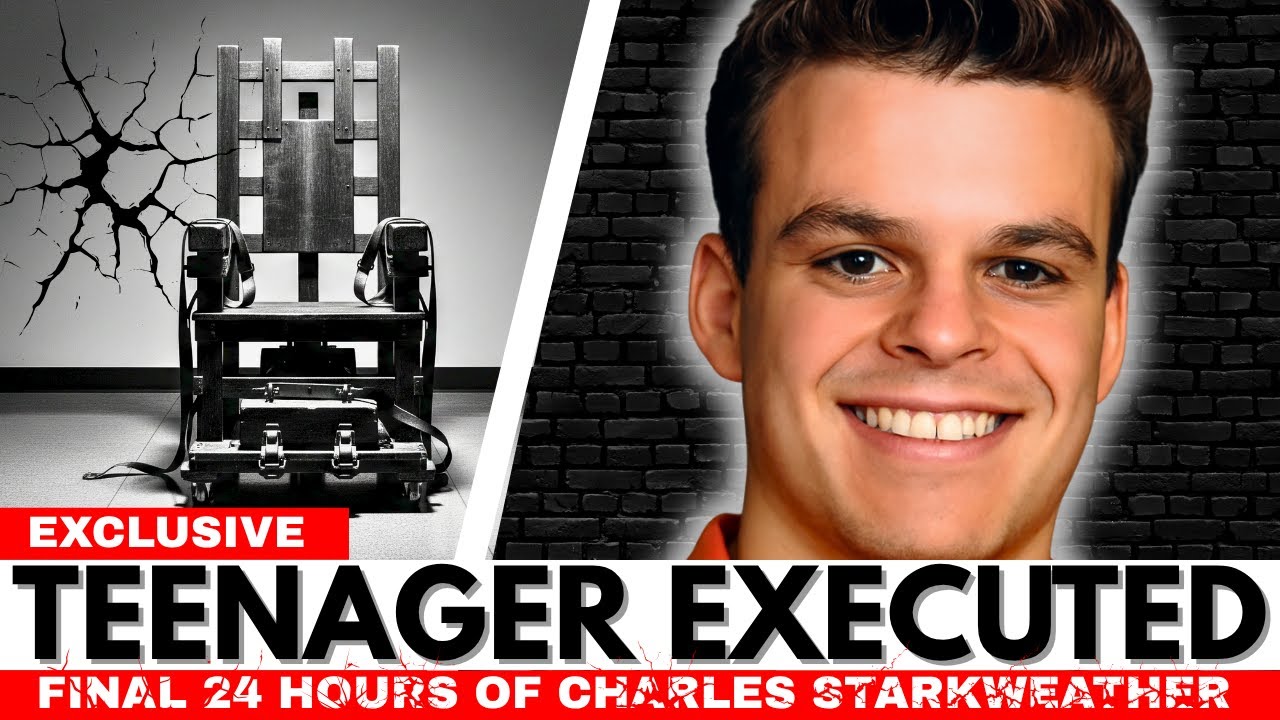
His final meal, consumed hours earlier, was simple: a steak, fried potatoes, garlic bread, and a strawberry milkshake. He offered no formal last words to the witnesses gathered at the Nebraska State Penitentiary. However, a letter to his parents revealed his chilling, unrepentant mindset: “But dad, I’m not really sorry, cuz for the first time, Carol and I had more fun.”
The path to that execution chamber was paved with unprecedented brutality that paralyzed the Midwest with fear in the winter of 1958. Starkweather’s first murder occurred in late November 1957, when he shot gas station attendant Robert Colvert during a robbery. This act unleashed a torrent of violence that reached its horrific peak two months later.
On January 21, 1958, Starkweather arrived at the Lincoln home of his 14-year-old girlfriend, Caril Ann Fugate. After a confrontation with her parents, Marion and Velda Bartlett, he shot them both at point-blank range. He then bludgeoned Fugate’s two-year-old sister, Betty Jean, to death. The bodies were hidden on the property as Starkweather and Fugate fled.
What followed was a chaotic trail of bloodshed. The couple killed a family friend, 70-year-old August Meyer, at his farm. They then abducted and executed two teenagers, Robert Jensen and Carol King, in a storm cellar. Their spree culminated in the vicious murders of wealthy industrialist C. Lauer Ward, his wife Clara, and their maid, Lillian Fencl.

A massive manhunt involving local police, the National Guard, and armed civilian posse failed to capture the fugitives as they crossed into Wyoming. Starkweather’s final victim was traveling salesman Merle Collison, murdered for his car outside Douglas, Wyoming. His capture came moments later due to a simple mechanical error—a parking brake he did not know how to release.
After a brief chase and a shot fired by a sheriff that shattered his windshield, Starkweather surrendered, believing he was dying from glass cuts. His arrest was abrupt and ignominious for a killer who had evaded a multi-state dragnet. Caril Ann Fugate immediately ran to law enforcement, claiming Starkweather had held her hostage.
Starkweather’s trial was a swift, tense affair. The prosecution presented overwhelming evidence, including stolen property, bloodstained clothing, and his own confessions. His defense argued mental disturbance stemming from a childhood of bullying over a speech impediment and bowed legs, but it could not counter the cold calculation of his crimes.
The jury found him guilty of first-degree murder after 22 hours of deliberation. When the judge sentenced him to death, Starkweather remained stoic and detached, offering no apology to the grieving families in the courtroom. His co-defendant, Caril Ann Fugate, was convicted as an accomplice and sentenced to life in prison, a verdict she contested for decades.

On death row, Starkweather’s demeanor remained unchanged. He exhibited no fear and made no last-minute appeals for clemency, which were swiftly denied by authorities. In interviews, he expressed a twisted worldview, even suggesting Fugate should die with him. He walked calmly to the electric chair, known as “Old Sparky,” and was executed without incident.
The execution brought a measure of closure to a traumatized region but ignited enduring debates about justice, punishment, and the nature of evil. For the families of the victims—the Bartletts, Jensen, King, Meyer, Ward, Fencl, and Colvert—his death ended a legal saga but could never heal their profound loss.
Caril Ann Fugate’s fate became a lasting point of controversy. After serving 17 and a half years, she was paroled in 1976, consistently maintaining she was a terrified hostage forced to comply under threat of death. Some lie detector tests supported her claims, leaving a complex legacy about coercion and culpability.
Charles Starkweather’s case remains a dark benchmark in American criminal history, a study of how alienation and rage can curdle into indiscriminate violence. His execution stands as a stark reminder of the justice system’s ultimate penalty, applied in a case where the sheer scale of brutality left little room for doubt, yet the questions about motive and morality linger decades later.
Source: YouTube