A seismic shift is occurring in our understanding of animal intelligence and the nature of language itself. Scientists from the Cetacean Translation Initiative (CETI) have, for the first time, decoded the fundamental building blocks of sperm whale communication, revealing a complex phonetic alphabet with structures eerily parallel to human language.
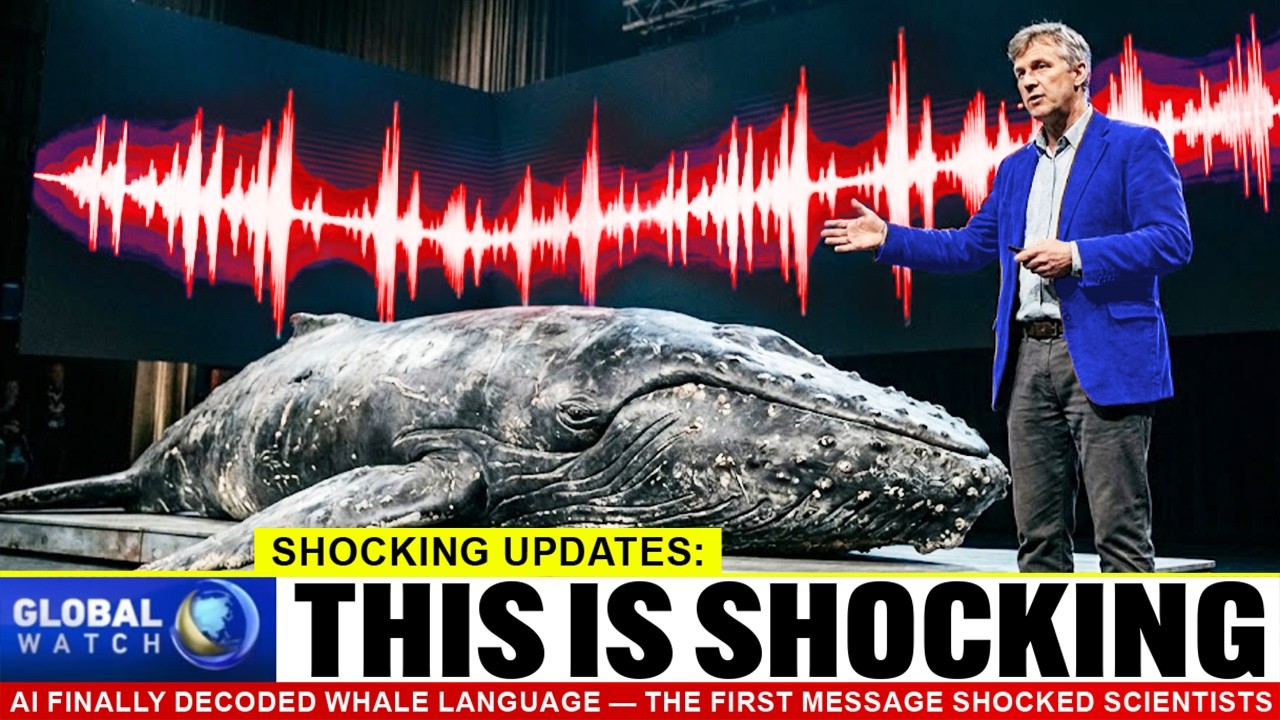
The breakthrough came after an artificial intelligence system analyzed a staggering 9,000 recordings of sperm whale vocalizations. What it found demolished decades of settled science. Researchers had long believed sperm whales communicated using about 21 simple click patterns, or “codas,” each with a fixed meaning.
The AI revealed not 21, but 156 distinct codas. More critically, it uncovered a layered internal structure within them. Each coda contains tempo variations, rhythmic shifts, and ornamentation clicks that function as modular units. These combine according to rules to generate meaning, mirroring how phonemes work in human language.
“This isn’t supposed to be possible,” one MIT researcher was heard whispering as the data processed. The system showed sperm whales are not broadcasting a fixed menu of signals. They are dynamically constructing communication from a generative system, the same fundamental architecture underlying every human language documented on Earth.
A subsequent, granular acoustic analysis delivered the second shock. Linguists discovered that the whales are producing precise vowel sounds. They identified the “ah” in “father,” the “e” in “see,” and diphthongs like the “oy” in “boy” within their clicks.
Vowels are not simple sounds. They require precise anatomical control and neural capacity, a combination long considered uniquely human. Their independent evolution in sperm whales suggests vowel-based communication may be a feature of high intelligence itself, not a fluke of human anatomy.

“This suggests a complexity that approaches human language,” said UC Berkeley linguist Gaspar Bakus. The finding represents a spectacular case of convergent evolution, where two lineages separated by 300 million years arrived at the same complex solution through entirely different paths.
The implications extend far beyond structure. Field observations from Dominica, where CETI has a permanent research station, show whales use this system with sophisticated social awareness. They alter their coda sequences depending on the listener and context, demonstrating real-time, pragmatic language use.
Exchanges can last an hour, featuring turn-taking, overlap, and responses that build on previous contributions. “It is hard not to see cousins playing while chatting,” said lead biologist Shane Gero, who has spent 13 years observing known whale families.
The creatures deploying this language possess the largest brains on the planet, six times the mass of a human’s. They live in matrilineal families with documented cultures, traditions, and cooperative hunting strategies that require intricate, real-time coordination in total darkness.
A critical distinction remains: while the alphabet and grammar are now mapped, not a single “word” has been translated. Meaning remains elusive. Project CETI’s next phase is a monumental correlation effort, matching specific vocalizations to observed behaviors using next-generation biologgers.
These tags record audio from three synchronized microphones alongside depth, movement, and the vocalizations of every nearby whale. The goal is to build a dictionary by linking sound to action within the whales’ complex social world.
The potential consequences of success are profound. The 1960s discovery that humpback whales sing songs sparked the global “Save the Whales” movement. Proving a non-human species possesses true language could redefine humanity’s relationship with nature.

“If sperm whales use language to discuss ideas, maintain relationships, and transmit cultural knowledge, do they qualify for legal personhood?” asked one legal scholar familiar with the research. The ethical, legal, and conservation stakes are unprecedented.
Commercial whaling slaughtered hundreds of thousands of sperm whales in the last century. Today, they face ship strikes and a cacophony of underwater noise pollution from shipping and sonar. If they are speaking, this noise constitutes more than environmental harm; it is the systematic disruption of a culture’s ability to communicate.
The whales have been using this system for millions of years. The matriarch of a pod alive today may have been born before sonar existed. She has spent a lifetime communicating in a language that science has just acknowledged.
Project CETI researchers now face a haunting question. What have these beings been saying as they witnessed human industrialization, the warming of the oceans, the disappearance of prey, and the loss of family to ships they could hear coming?
The alphabet is cracked. The grammar is modeled. The first message was sent long ago. Scientists are now, for the first time, listening closely enough to begin the work of understanding what it says. The world awaits the first translated sentence.
Source: YouTube