The final, harrowing journey of a condemned war criminal unfolded on the streets of Nanjing today, a grim procession witnessed by thousands seeking closure for one of history’s darkest chapters. Lieutenant General Hisao Tani, the architect of the Nanjing Massacre, was executed by firing squad after a slow, public drive through the city his troops had ravaged a decade prior.
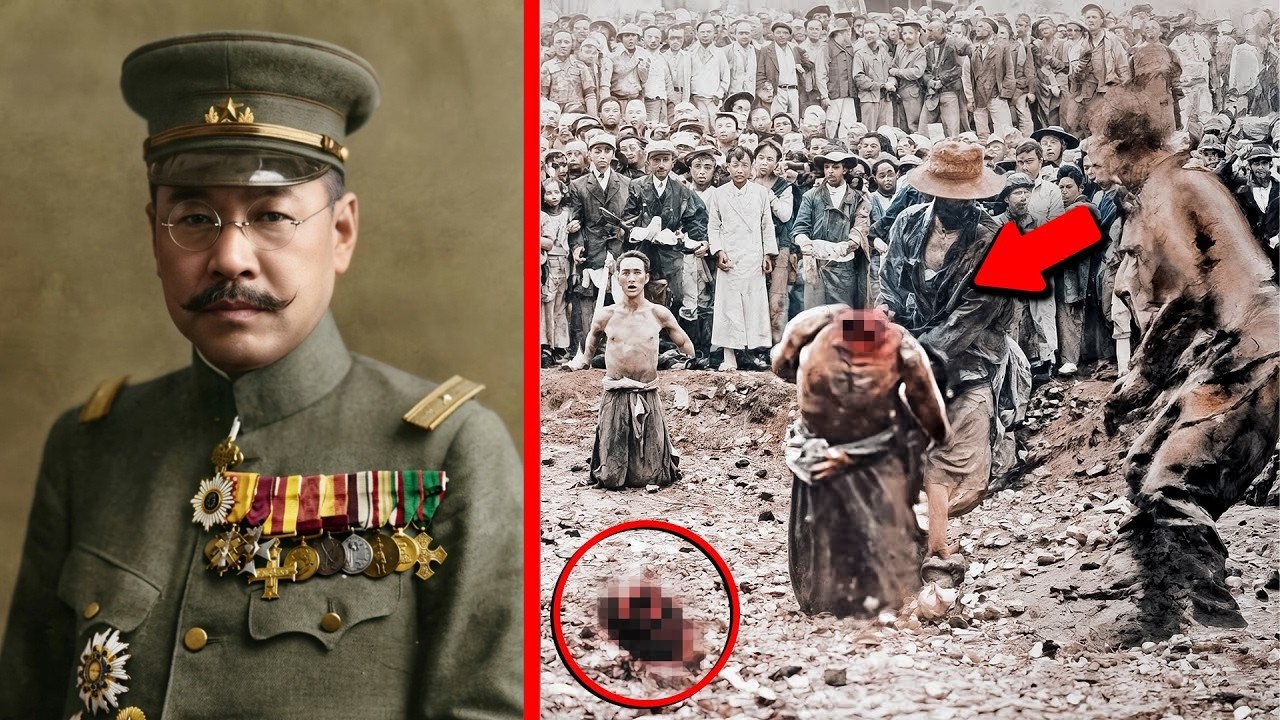
The 64-year-old former commander of the Imperial Japanese Army’s Sixth Division spent his last morning in a cold prison cell performing a meticulous personal ritual. He clipped his fingernails, cut three strands of his own hair, and folded them into a handkerchief destined for his homeland. His final act was composing a short poem reflecting on cherry blossoms and his impending death.
Two hours later, bound and placed in the back of a military truck, Tani was transported to his execution at Mount Yuhuatai. The drive, lasting approximately ninety minutes, became a cathartic spectacle for a wounded city. An estimated ten thousand survivors and relatives of victims lined the route, their screams and curses filling the air as some threw stones and chased the vehicle.
Tani, who had presided over six weeks of systematic slaughter in late 1937 and early 1938, presented a broken figure by journey’s end. Eyewitnesses, including survivor Yu Changxiang, reported the general’s legs shook uncontrollably inside the truck. Upon arrival, he was reportedly so overcome with fear that military police had to drag him toward the execution slope.
A single pistol shot to the back of the head ended his life. The crowd erupted in a visceral cry of long-deferred justice. His body, tied to a bamboo pole, was carried to an unmarked grave in nearby vegetable fields, where he was buried without ceremony. The handkerchief containing his hair and nails was later repatriated to Japan.

This dramatic conclusion followed a highly publicized trial that captivated a nation. The proceedings, held at the Lizhi Che Auditorium beginning February 6, were broadcast to crowds outside via loudspeaker. Survivors provided devastating testimony, presenting physical scars and photographs of lost relatives, while film evidence directly linked Tani to mass execution sites.
Tani’s defense, which attempted to blame Korean auxiliaries and other divisions while claiming ignorance of his own troops’ actions, was dismissed by the court as wholly insufficient. Presiding judges found him directly responsible for failing to control his command, leading to the deaths of hundreds of thousands. The Nanjing District Court sentenced him to death on March 10.
An immediate appeal to Chinese President Chiang Kai-shek was rejected just one day before the execution was carried out, sealing Tani’s fate. His capture and trial followed a failed escape plot hatched by loyal former subordinates in Shanghai, which was uncovered by Chinese intelligence.
The execution brings a symbolic, if belated, measure of reckoning for the atrocities committed under Tani’s command. International estimates and the findings of the postwar tribunal describe a campaign of terror where soldiers conducted mass shootings of bound prisoners along the Yangtze River, turning the water red. The official Chinese memorial in Nanjing records a death toll exceeding 300,000.

Beyond the killings, the massacre was marked by widespread and systematic sexual violence. Contemporary diaries from foreign observers trapped in the city, including German businessman John Rabe and American professor Miner Searle Bates, documented scenes of brutal assault against women and girls of all ages, accounts so graphic they were suppressed for years.
Historians remain divided on whether Tani explicitly ordered the rampage or merely permitted it through deliberate inaction. The tribunal evidence firmly established he was present in the city and in operational command during the worst of the violence, issuing no orders to restrain his troops. This command responsibility formed the legal cornerstone of his conviction.
The public nature of his final transport and execution served as a powerful, state-sanctioned moment of collective mourning and anger for the people of Nanjing. For the driver of the truck, Tang Zeqi, the memory of that drive through a sea of anguish would remain vivid for decades. The event stands as one of the most publicly visceral war crimes executions in modern history.
Tani’s life story underscores a profound transformation from humble origins to a figure of historical infamy. Born to a poor farming family in Okayama in 1882, he ascended through military academies, graduating near the top of his class. His early combat experience in the Russo-Japanese War hardened him, setting him on a path that led to command of the notoriously brutal Sixth Division.
His legacy is now inextricably tied to the soil of Nanjing. The poem he wrote in his cell, yearning for an end to hatred, lies in stark contrast to the unmarked grave he occupies, a permanent testament to the consequences of command failure and unimaginable cruelty. The city he helped destroy has finally witnessed the culmination of its long quest for justice.
Source: YouTube