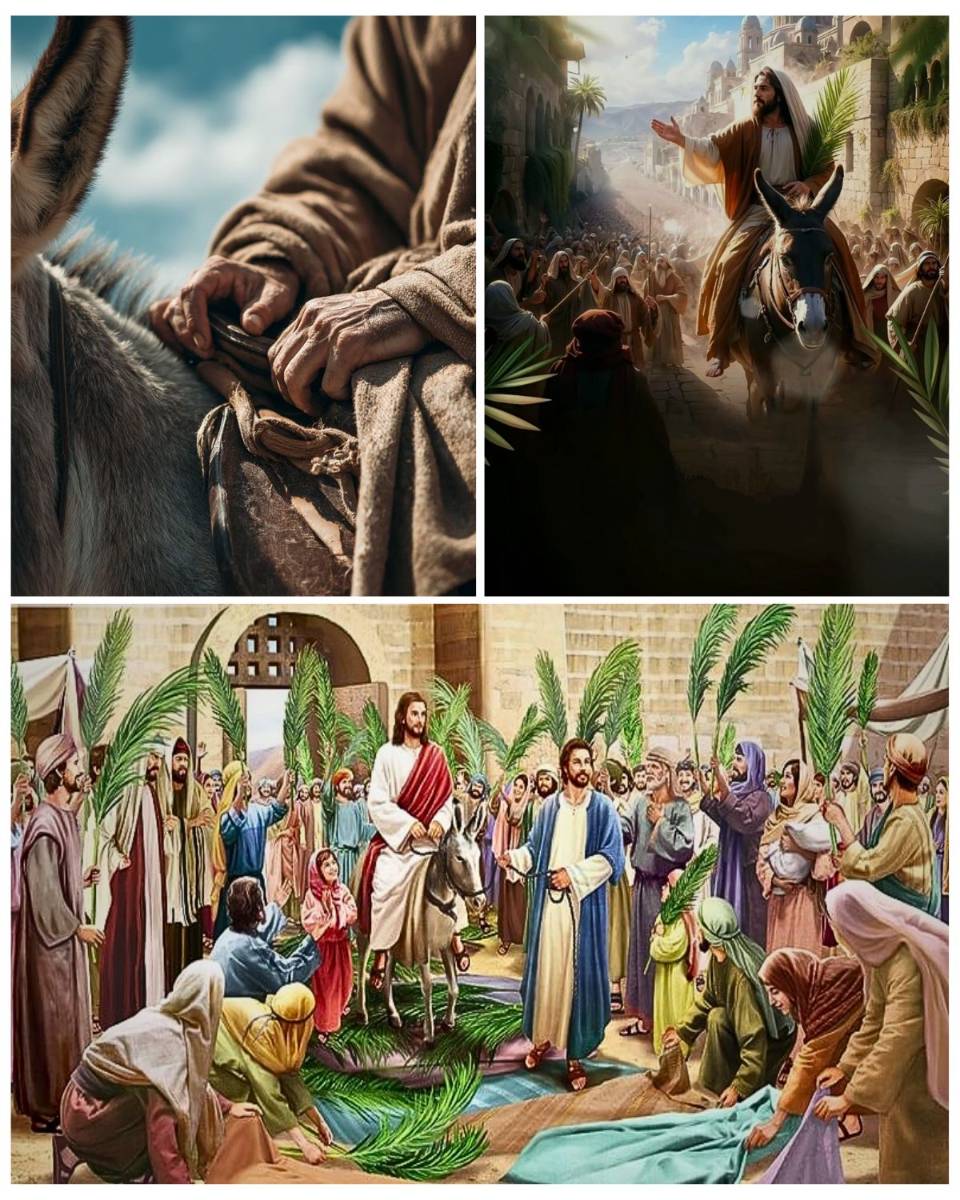
A wave of fervent anticipation swept through the ancient streets of Jerusalem today as Jesus of Nazareth entered the city in a dramatic, prophecy-fulfilling procession. Crowds thronged the route, transforming the thoroughfares into a scene of messianic celebration and political tension. The event, occurring at the start of the sacred Passover week, has electrified the populace and set the city’s religious and Roman authorities on high alert.
 Eyewitnesses describe a deliberate and symbolic arrival, with Jesus directing disciples to procure a young donkey from the nearby village of Bethphage. This act directly invoked the words of the prophet Zechariah, signaling a claim to kingship that is both righteous and humble. The choice of a donkey, a beast of peace, stood in stark contrast to the war horses of Roman governors.
As he rode toward the city gates, a spontaneous celebration erupted among pilgrims who had gathered for the festival. People stripped off their outer cloaks, laying them on the dusty path to create an impromptu royal carpet. Others rushed into the fields, cutting down palm branches to wave as symbols of victory and national triumph.
The air filled with shouts of “Hosanna!”—a cry meaning “save us”—and the declaration, “Blessed is he who comes in the name of the Lord!” For many in the crowd, this was the long-awaited moment: a Davidic king arriving to claim his throne and liberate the nation from occupation. The scene was one of uncontainable hope and revolutionary zeal.
However, sources close to Jesus’s inner circle indicate this triumphant entry is merely the opening act of a pre-determined and perilous mission. Analysts note that entering the city in such a publicly provocative manner during the politically volatile Passover festival is a direct challenge to both the Temple elite and Roman power.

Security forces were visibly monitoring the procession from a distance. Roman legionaries stationed along the walls of the Antonia Fortress observed the crowds with heightened alertness. The Temple guard, under the direction of the chief priests, is reported to be deeply troubled by the potential for unrest and the threat Jesus poses to the fragile status quo.
Theological experts confirm the significance of the fulfilled prophecy from Zechariah 9:9. “This is not a random gesture,” stated one scholar. “By deliberately orchestrating this entry, Jesus is publicly declaring his identity and his mission. He is presenting himself as the promised king, but redefining kingship itself as one of peace and sacrifice.”
Despite the public adulation, witnesses close to the teacher report a profound solemnity in his demeanor. He observed the celebrating crowds and the city skyline with what is described as a heavy heart, fully aware of the confrontation and suffering that this path necessitates. This entrance marks a point of no return.
The procession culminated near the Temple complex, where Jesus reportedly surveyed the activity within the outer courts before departing for Bethany as evening fell. The city remains abuzz with speculation about his next move. Many expect a major teaching or prophetic act in the coming days that could further escalate tensions.
Political observers warn the situation is a tinderbox. The Roman prefect, Pontius Pilate, who entered Jerusalem with military pomp earlier in the week, represents the crushing power of empire. Jesus’s counter-entry on a donkey creates a stark and intentional visual contrast, a symbolic challenge that authorities are unlikely to ignore.

For his followers, the event is both a moment of validation and deep anxiety. They have seen his authority over illness and nature, but now he has walked directly into the lion’s den. The cheers of “Hosanna” are sweet, but the fear of what the ruling powers will do next is palpable.
The timing is critical. With Jerusalem’s population swollen by hundreds of thousands of pilgrims, the Roman government is at its most nervous and repressive. Any figure attracting a large following is seen as a potential instigator of revolt, meriting swift and brutal response.
This narrative of a king riding a donkey, welcomed by the poor and the hopeful, stands as one of the most politically and spiritually charged events in recent memory. It is a calculated action that forces a decision from every segment of society: the people, the priests, and the occupiers.
As night falls on Jerusalem, the palm branches lie trampled in the streets. The echoes of the crowds have faded. But the implications of this day’s events are just beginning to unfold. The city holds its breath, waiting for the next development in what promises to be a week of unprecedented drama.
The coming days will test the resolve of the teacher from Galilee and the loyalties of the entire city. This triumphant entry is not a culmination, but a commencement. The path now leads from the public square to the shadow of the cross, a journey undertaken with deliberate, world-altering purpose.
All eyes are now fixed on Jesus’s movements. Will he retreat, or will he press his message at the very heart of Jewish worship? The Temple authorities are convening emergency meetings. The potential for a major incident that could shatter the Passover peace is now the primary concern for all governing bodies.

The story of this entrance will undoubtedly spread far beyond Jerusalem’s walls via pilgrims returning to Galilee, Judea, and the Diaspora. It marks a definitive turn in the ministry of Jesus, moving from regional teaching to a direct, symbolic confrontation in the nation’s capital.
For the common people who waved branches and shouted their hopes, this day will be etched in memory. They have participated in what they believe is the dawn of a new kingdom. The disconnect between their expectation of a liberating warrior and Jesus’s mission of sacrificial love is the central tension of the hours ahead.
The event underscores a powerful dichotomy: the king who conquers not with swords but with surrender, who claims victory not through taking life but by giving his own. In an empire built on violence, this inverted triumph poses the most radical threat imaginable.
As we report from Jerusalem, the atmosphere is one of electric uncertainty. The celebration has ended, but the revolution of values it represents is just beginning. The actions of the next few days will determine whether this hopeful entrance concludes in tragedy or in a triumph far stranger than anyone currently anticipates.
The world watches, though it does not yet understand what it is witnessing. A new definition of power has ridden through the city gates, and its collision with the old orders is now inevitable. The story continues tomorrow.