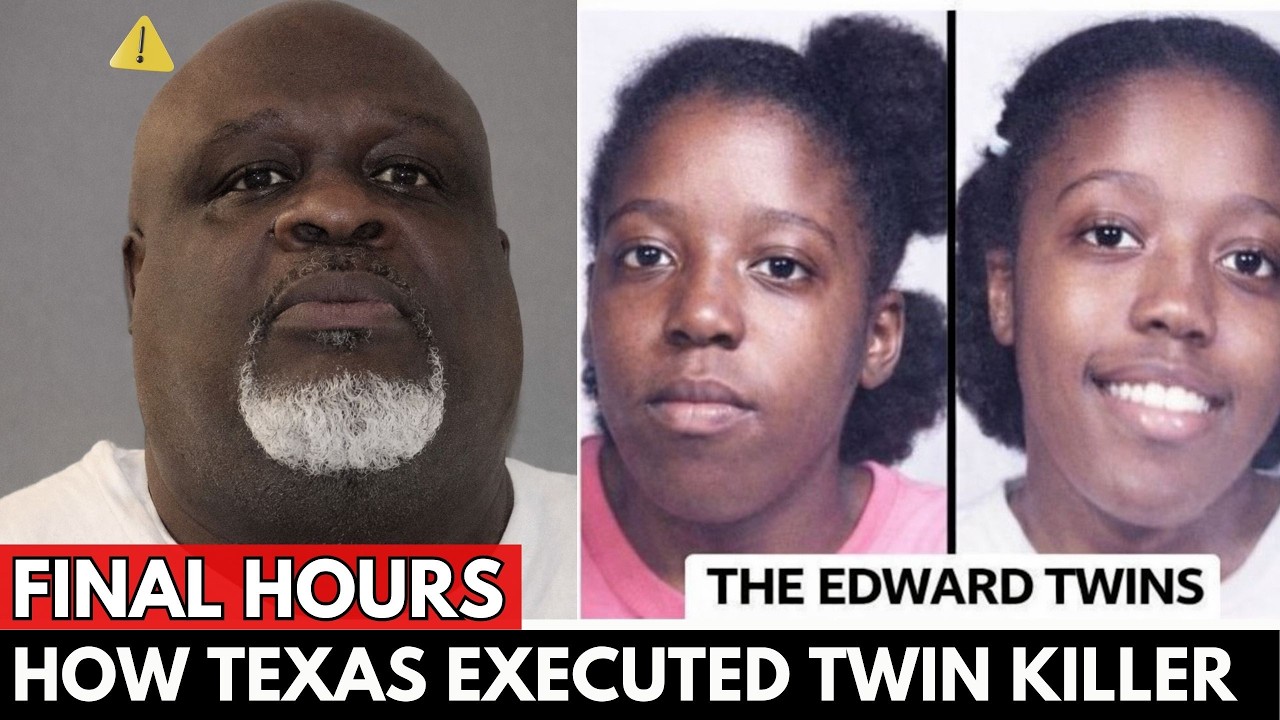
In a stark and somber turn, Texas has executed 61-year-old Garcia Glenn White for the savage murders of twin teenage girls, ending a 28-year death row ordeal that gripped the nation. Strapped to a gurney in Huntsville, White offered final words of remorse and sang a hymn before lethal injection stopped his heart at 6:39 p.m.
 The execution caps a decades-long saga of violence and addiction that shattered multiple families. White, once a promising high school football star, spiraled into a crack cocaine nightmare, transforming from a gentle athlete into a killer responsible for five brutal deaths.
His crimes began in 1989, starting with the beating death of Greta Williams, a woman he encountered in Houston’s 𝒹𝓇𝓊𝑔-fueled underworld. Prosecutors painted White as a man whose addiction fueled calculated evil, not mere mistakes.
The most harrowing murders involved Bonita Edwards and her twin daughters, Annette and Bernett, just days after their 16th birthday. White stabbed Bonita in a frenzied attack, then pursued the screaming girls as they fled in terror.
Annette was sexually assaulted and stabbed repeatedly in her bedroom, while Bernett fought desperately in the bathroom before meeting the same fate. The apartment became a scene of unimaginable horror, with blood staining walls and floors.
Years later, in 1995, White’s robbery of a convenience store led to the death of Hyan Fam, a Vietnamese immigrant father of seven. This crime finally unraveled his past, linking him to the cold Edwards case through DNA and a tip from an accomplice.
Authorities arrested White, and his videotaped confession revealed the full extent of his atrocities. Jurors in 1996 convicted him of capital murder, citing the deliberate nature of his acts and his ongoing threat to society.
Despite appeals highlighting White’s borderline intellectual functioning and 𝒹𝓇𝓊𝑔-induced violence, courts upheld the death sentence. His attorneys argued he was non-violent when sober, pointing to his model behavior on death row.
 As the execution date approached, White’s story sparked debates about addiction, redemption, and the death penalty’s role. Supporters claimed prison isolation made him harmless, while victims’ families demanded closure for long-endured pain.
In his final moments, White addressed the Edwards family, apologizing for the irreparable harm. He sang “I Trust in God,“ a hymn reflecting his prison-found faith, as witnesses watched in silence.
The lethal injection—using pentobarbital—proceeded swiftly, with White’s breathing growing labored before he slipped away. This execution, Texas’s latest, underscores the state’s unyielding stance on capital punishment amid national scrutiny.
White’s journey from a loving Houston family to death row exemplifies how the crack epidemic devastated lives in the 1980s. Born in 1963, he excelled in sports until injuries derailed his dreams, leading to addiction and despair.
Neighbors and relatives remembered him as kind before drugs took hold, frequenting crack houses where arguments turned deadly. His transformation raises questions about mental health and systemic failures in addressing addiction.
For the victims’ kin, justice arrived too late. Greta Williams’ sister spoke of the agony of her unsolved murder, while Hyan Fam’s son recounted watching his father die in that fateful robbery.

The Edwards family, absent from the execution, has lived with the trauma for decades. Their loss symbolizes the broader toll of violent crime on communities, especially in underserved areas like Houston.
As news of White’s death spreads, it reignites calls for criminal justice reform. Critics argue that long waits on death row, like White’s 28 years, highlight flaws in the system, including racial biases and inadequate mental health support.
Prosecutors, however, emphasized the premeditated brutality of his crimes, from the rape and stabbing of innocents to the calculated disposal of bodies. They view the execution as a necessary end to a reign of terror.
White’s last words, broadcast in reports, offered a glimpse of humanity amid the horror. His apology and hymn stirred mixed emotions, prompting reflections on forgiveness and the cycle of violence.
In Houston, where these tragedies unfolded, residents grapple with the legacy of the crack era. Community leaders push for better resources to prevent such paths, urging prevention over punishment.
The execution draws international attention, with human rights groups condemning capital punishment as inhumane. Yet, in Texas, it remains a tool for accountability in the face of heinous acts.

White’s story, from athletic promise to lethal injection, serves as a cautionary tale. It exposes the intersection of poverty, addiction, and violence, challenging society to address root causes before more lives are lost.
As dawn breaks over Huntsville, the focus shifts to healing for survivors. The Edwards twins, Bonita, Greta, and Hyan—lives cut short—leave a void that no verdict can fill, but perhaps this closure brings some peace.
Reports from the prison confirm the procedure was carried out without incident, adhering to state protocols. Witnesses, including victims’ relatives, exited in silence, their long wait for justice finally over.
This event marks another entry in America’s complex death penalty debate, where urgency meets morality. As appeals end, the nation reflects on whether such measures deter crime or perpetuate pain.
White’s execution, while final, opens doors to broader discussions on reform. From 𝒹𝓇𝓊𝑔 policy to sentencing, his case underscores the need for change in a system that often fails the vulnerable.
In the end, the story of Garcia Glenn White is one of tragedy multiplied. For the families left behind, it’s a reminder that justice, though delayed, can still deliver a measure of resolution.
The urgency of this breaking news compels action and awareness, urging all to confront the forces that lead to such devastating outcomes. Texas’s decision reverberates, a stark headline in the ongoing saga of crime and consequence.
Source: YouTube