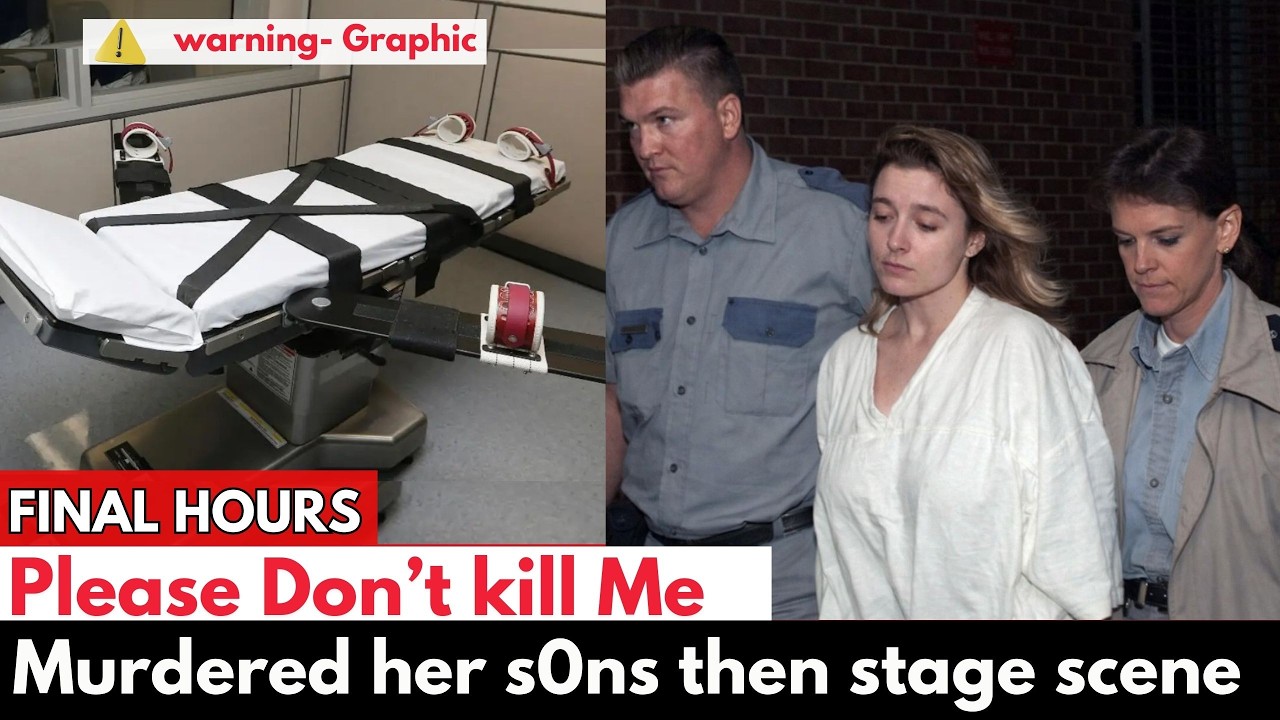
A Texas mother convicted of murdering her two young sons nearly three decades ago remains on death row as a complex legal battle and unresolved questions about her guilt continue to unfold. Darlie Routier, now 54, was sentenced to death for the 1996 stabbing deaths of her sons Devon, 6, and Damon, 5, in the family’s Rowlett home, a case that has divided public opinion and legal experts for years.
The crime scene on June 6, 1996, presented a horrifying tableau. Police responding to Darlie’s frantic 911 call found Devon dead and Damon mortally wounded on the family room floor. Darlie herself had a severe neck wound that came within two millimeters of her carotid artery. She claimed an intruder had attacked them before fleeing into the night.
Investigators quickly grew skeptical of her story. No evidence of forced entry was found, and a cut window screen showed undisturbed dust. Blood spatter analysis suggested staging, with circular drops in the utility room indicating someone standing still, not chasing an assailant. A bloody sock belonging to the family was found 75 yards away.
The prosecution built a case portraying Darlie as a materialistic woman overwhelmed by financial troubles and motherhood. They presented evidence of significant debt and a failed loan application. A diary entry read, “Forgive me for what I’m about to do,” which prosecutors argued showed premeditation.
A pivotal moment came eight days after the murders at Devon’s graveside birthday memorial. A news clip showed Darlie spraying silly string and laughing, creating a devastating public image. This 15-second video was played repeatedly at trial, though the full context—including a preceding solemn prayer service—was not shown to jurors.
The jury convicted Darlie after just four hours of deliberation in 1997 and sentenced her to death. She has maintained her innocence from prison, claiming a mysterious intruder committed the murders. Her appeals have focused on disputed forensic evidence and potential alternative suspects.

New questions emerged years later when Darlie’s father-in-law revealed that her husband, Darren, had discussed staging a burglary for insurance money months before the murders. Darren initially denied, then admitted to the conversation, and to a prior car insurance fraud. This revelation suggested alternative scenarios to some observers.
Advanced DNA testing ordered in 2014 and expanded in 2018 has yet to provide conclusive results. Some samples have degraded beyond use over nearly three decades. The testing process remains ongoing, holding both the promise of exoneration and the possibility of confirming guilt.
Several original trial participants have expressed doubts. Author Barbara Davis, who initially believed Darlie guilty, changed her position after seeing photographs of extensive bruising on Darlie’s body. One juror signed an affidavit stating he would not have convicted had he seen the complete, unedited cemetery video.
Darlie’s defense team continues to pursue all legal avenues, including a federal habeas corpus petition filed in 2005 that remains pending. They argue that tunnel vision by investigators, questionable forensic science of the era, and prejudicial media coverage led to a wrongful conviction.
Prosecutors remain confident in the original verdict, pointing to what they describe as overwhelming evidence of guilt. They note that nothing was stolen during the alleged home invasion, and that Darlie’s injuries, while serious, showed characteristics some medical experts testified could be self-inflicted.

The case highlights enduring challenges in capital punishment jurisprudence. With the original crime scene gone, witnesses aged or deceased, and forensic science evolving, obtaining definitive answers grows increasingly difficult. Public fascination continues through documentaries and podcasts that re-examine the evidence.
Darlie Routier now spends her days at the Patrick O’Daniel Unit in Gatesville, Texas, one of only seven women on the state’s death row. She has outlived her executed sons by more than 27 years, maintaining a routine of limited recreation, reading, and correspondence with supporters.
Her ex-husband, Darren, who testified for the prosecution at trial, divorced her in 2011 and remarried. Their youngest son, Drake, who was an infant at the time of the murders, is now 29 years old and has known his mother only through prison visits.
No execution date has been set, and with ongoing DNA testing and appeals, none is expected in the foreseeable future. The Texas Court of Criminal Appeals continues to review motions as both sides await potentially conclusive scientific evidence.
The case stands as a stark reminder of the finality of the death penalty and the complex interplay of forensic science, media influence, and human psychology in the pursuit of justice. For the families of Devon and Damon Routier, and for Darlie herself, the search for truth continues behind prison walls and courtroom doors.
As technology advances and legal standards evolve, this decades-old case remains very much alive, embodying the profound questions about guilt, innocence, and justice that define America’s ongoing debate over capital punishment. The story of what truly happened in that Rowlett home continues to resist a simple narrative, ensuring its place in true crime annals for years to come.
Source: YouTube