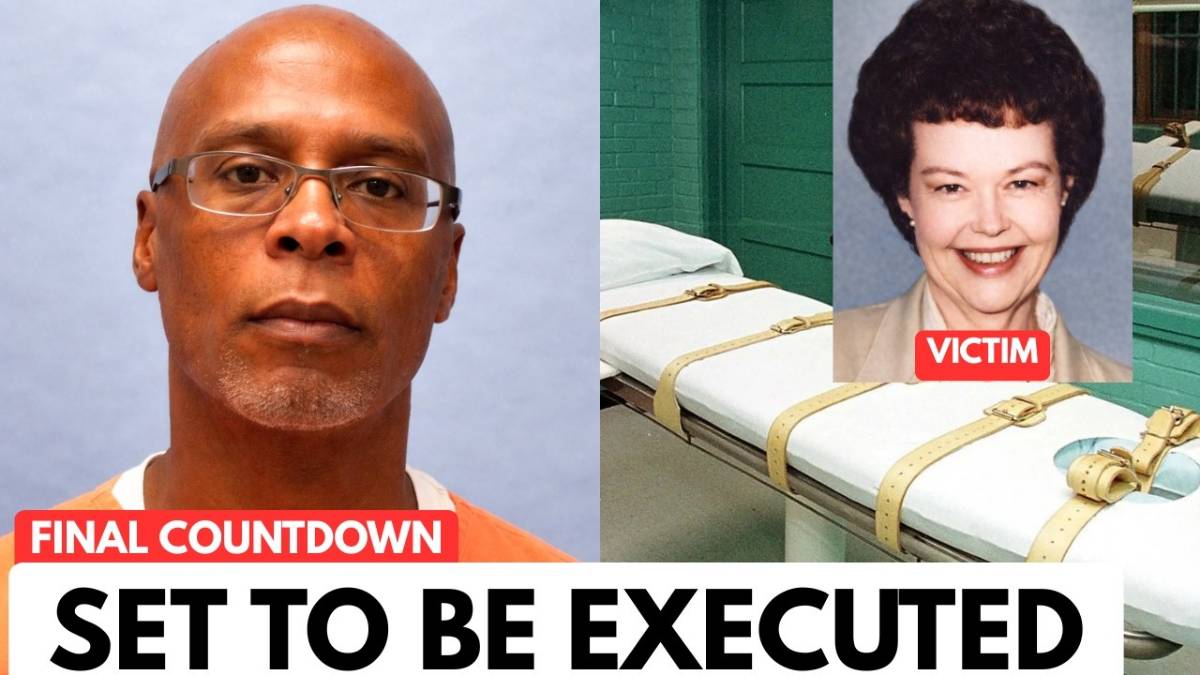
A Florida death row inmate is scheduled to be executed Tuesday evening for one of the state’s most notorious and brutal murders, culminating a legal saga spanning more than three and a half decades. Chadwick Willacy, now 57, is set to die by lethal injection at Florida State Prison for the 1990 murder of his 56-year-old neighbor, Marla Mae Saether, a crime that shocked the quiet community of Palm Bay with its calculated cruelty.
 The execution is set for 6:00 p.m. Eastern Daylight Time on April 21, 2026. Willacy has been on death row since 1992, convicted of first-degree murder, burglary, robbery, and arson. His scheduled death marks Florida’s sixth execution this year, continuing an unprecedented pace of capital punishment in the state under Governor Ron DeSantis.
The crime unfolded on September 5, 1990, a Wednesday afternoon. Marla Saether, a widow, returned to her home during a lunch break from work. There, she encountered Willacy, her 22-year-old next-door neighbor, burglarizing her residence. What followed was a prolonged and horrific assault that would be detailed in grim court records.
Willacy attacked Saether with objects found in the home, inflicting severe blunt force trauma to her head. He then bound her wrists and ankles. Court documents state he used a cord to restrict her breathing with such extreme force that a portion of her skull was dislodged. Despite her injuries, Saether was still alive.
The assailant then took her car keys and ATM card, driving her late husband’s car to a bank where surveillance cameras captured him withdrawing $200. He returned to the house, loaded her property, and stashed the vehicle nearby. Willacy then made a decision that defined the atrocity of the crime.
He retrieved a gas can from the garage, disabled every smoke detector in the home, and doused the bound and beaten woman with gasoline. Deliberately positioning a fan at her feet to feed oxygen to the flames, he set Marla Saether on fire and walked away. The official cause of death was smoke inhalation.

Her body was discovered by her son-in-law after her employer reported she had not returned from lunch. The evidence against Willacy mounted swiftly. His fingerprints were found on the fan, the gas can, and a tape rewinder in the home. Witnesses placed him near the scene and driving Saether’s car.
A critical break came when Willacy’s own girlfriend, Marissa Walcott, found Saether’s check register in his wastebasket and contacted police. A search of his home revealed Saether’s property and clothing stained with blood consistent with her type. Faced with overwhelming evidence, a jury found him guilty in December 1991.
The jury recommended death by a vote of 9 to 3. The judge imposed the sentence, beginning a labyrinthine appellate process. In 1994, the Florida Supreme Court upheld his convictions but overturned the death sentence, ordering a new penalty phase. A second jury recommended death by an 11 to 1 vote in 1995.
For over thirty years, Willacy’s case wound through state and federal courts. Motions for post-conviction relief and petitions for writs of habeas corpus were consistently denied. His attorneys argued unsuccessfully that his sentence was invalidated by a later Supreme Court ruling on jury unanimity.

The path to Tuesday’s execution date accelerated dramatically in early March 2026. Willacy’s legal team filed public records requests seeking documentation on Florida’s lethal injection protocol, citing emerging concerns about expired drugs and deviations from official procedure. No state agency responded.
Six days after those requests were filed, Governor Ron DeSantis signed Willacy’s death warrant. His attorneys have argued the timing was retaliatory, designed to short-circuit transparency efforts. They have filed a petition for a writ of mandamus, asking the Florida Supreme Court to compel the state to produce the records.
They contend the state is preparing an execution while blocking access to information needed to assess its lawfulness. As of this reporting, those proceedings remain ongoing, creating a last-minute legal clash over execution transparency just hours before the scheduled lethal injection.
This case unfolds against a backdrop of unprecedented execution activity in Florida. The state carried out a modern-era record of 19 executions in 2025, more than double its previous annual record. With Willacy’s, 2026 will see its sixth execution, maintaining a pace far exceeding any other state.

Ahead of him this year were Ronald Heath, Melvin Trotter, Billy Leon Curse, and Michael King. Legal observers note a pattern of death warrants being signed shortly after inmates file requests for information about execution protocols, a dynamic highlighted by U.S. Supreme Court Justice Sonia Sotomayor.
Willacy, who now uses the name Khaliil, is described by his defense as a man transformed by 35 years of incarceration. They point to his engagement in faith and programming, arguing the addicted 22-year-old who committed the crime no longer exists. This claim of rehabilitation is a final, often-voiced plea in capital cases.
For the family of Marla Saether, Tuesday represents a long-delayed conclusion. They have endured the original trial, a resentencing, and decades of appeals. The son-in-law who discovered her charred remains has waited over 35 years for this date, a span of time that underscores the protracted nature of capital litigation.
The execution of Chadwick Willacy will close one of Florida’s most gruesome murder cases. It also fuels an intensifying national debate over the death penalty’s application, the secrecy surrounding execution methods, and the meaning of justice after a wait measured in decades. The final act is scheduled for 6 p.m.
Source: YouTube