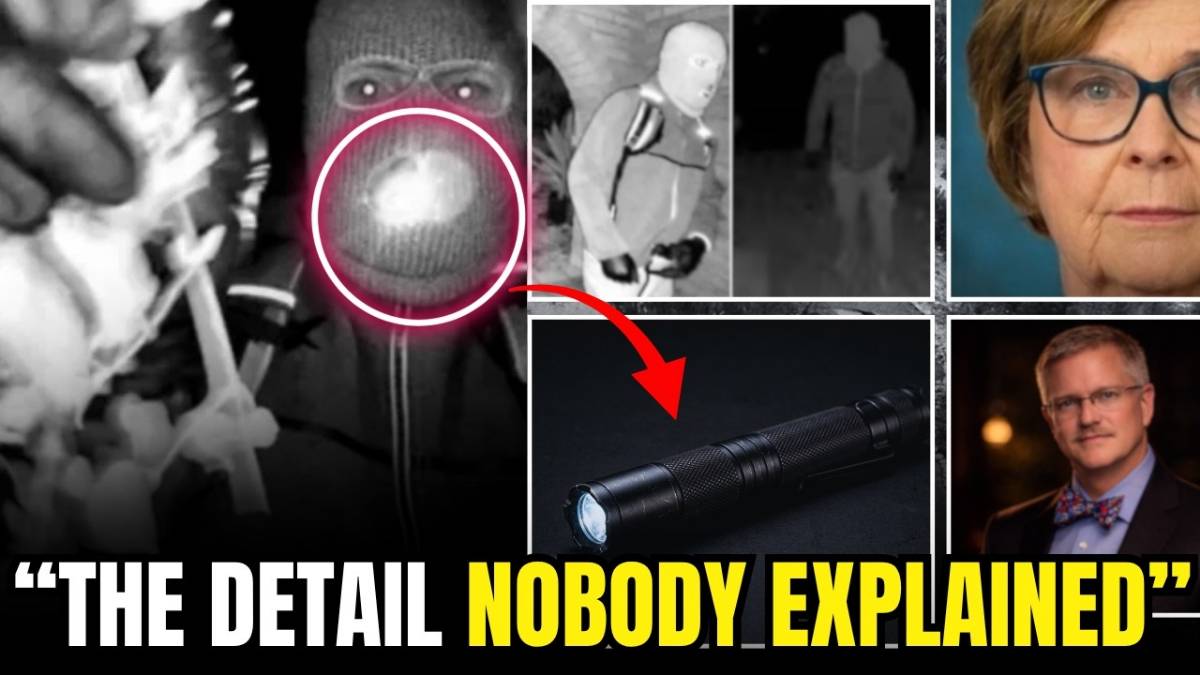
The most revealing clue in the hunt for Nancy Guthrie’s abductor was not hidden in the shadows of the FBI’s footage—it was held in plain sight, illuminated between the suspect’s own teeth. A retired detective’s analysis of a simple flashlight has provided investigators with what experts call one of the most critical behavioral profiles in the 56-day investigation into the 84-year-old woman’s disappearance from her Tucson home.
 That fleeting moment on the Nest doorbell footage shows the masked figure, hands occupied dismounting the camera, using his mouth to hold a small light. To the untrained eye, it was a minor detail mentioned in passing by news reports. To former Lexington police commander David Lyons, it was a signature.
“Not many people instinctively hold a flashlight in their mouth,” Lyons stated publicly, “but those who work in the trades might, such as an electrician or a plumber.” This automatic act, he explained, points to deeply ingrained muscle memory from years of labor in tight, dark spaces, a habit so procedural it surfaced even during a meticulously planned crime.
The implications of this observation are now converging with digital, forensic, and behavioral evidence to shape a focused manhunt. The FBI has specifically requested lists of contractors and construction workers who were active in the Catalina Foothills neighborhood in January and February. This targeted appeal suggests the investigative framework includes someone with professional access to the area.
Former FBI profiler Mary Ellen O’Toole bolstered this assessment, noting the suspect’s “casual” and “comfortable” demeanor on the porch of a home where he did not belong. “If this is the first time you’ve done something like this, how do you know how to dress like that?” she asked, indicating prior experience in similar environments.
 This portrait of a trades worker is further refined by the suspect’s age, estimated by former FBI profiler Jim Clemente to be in his 30s or 40s—a period of fully formed occupational habits. Clemente also stressed the suspect “definitely exhibited pre- and post-offense behavior that people around him can see,” a direct appeal to the suspect’s community.
Crucially, the flashlight habit may have delivered a fatal investigative blow to the suspect’s efforts to avoid identification. By placing the light in his mouth, he likely deposited a rich source of saliva-borne DNA onto its surface.
Forensic professor April Stonehouse of Arizona State University was unequivocal: “I would want to swab the end of that flashlight… he’s leaving saliva behind, and that’s a really strong source of DNA.” This material could provide a gold-standard genetic profile.
Genetic genealogist CeCe Moore, who has been formally consulted on the case, expressed pointed optimism about the DNA evidence. She explained that saliva from the flashlight could have transferred to the suspect’s gloves, and subsequently to surfaces inside the home where unknown male DNA has already been found.

“I believe if they haven’t collected his DNA, it is still at that crime scene somewhere,” Moore stated. She confirmed the unknown DNA did not match any profile in the national CODIS database, making it a prime candidate for genetic genealogy—the technique that identified the Golden State Killer.
Investigators are also focused on a pattern of three consecutive Saturdays: January 11th, January 24th, and the night of the abduction, February 1st. The FBI has requested Ring camera footage from these dates, and Sheriff Chris Nanos confirmed their analysis suggests activity at Guthrie’s home on January 11th.
This pattern aligns with a Monday-Friday worker using weekends for reconnaissance. Neighbors have reported unusual activity and vehicle sightings on these Saturday evenings, and a utility box near the home, damaged around the time of the crime, is under investigation for potentially causing internet outages.
 The vehicle captured on a back road at 2:36 a.m. on February 1st, analyzed by a retired NYPD detective as potentially a Kia Soul, represents another tangible lead. The suspect’s backpack, identified as a Walmart Ozark Trail model, has also prompted a review of purchase records.
In contrast to the proficient flashlight habit, former FBI agents have noted the suspect’s holster is positioned incorrectly by tactical standards, suggesting practical competence without formal military or law enforcement training.
The victim’s daughter, Today show anchor Savannah Guthrie, made a raw public appeal this week, stating her family “cannot be at peace without knowing.” She will return to the Today show on April 6th, a move former FBI agent Jason Pack said would keep national attention on the case and potentially prompt a crucial tip.
The FBI continues to process over 40,000 tips. The reward for information leading to Guthrie’s recovery or an arrest stands at $1.2 million. Anyone with information is urged to contact the FBI at 1-800-CALL-FBI or online at tips.fbi.gov.
As the genetic genealogy work proceeds and the contractor lists are scoured, investigators are building a case they believe will lead to a name. That path may well have been lit from the very beginning by a small, unthinking act—a flashlight held in a mouth, revealing the hands that held it.
Source: YouTube