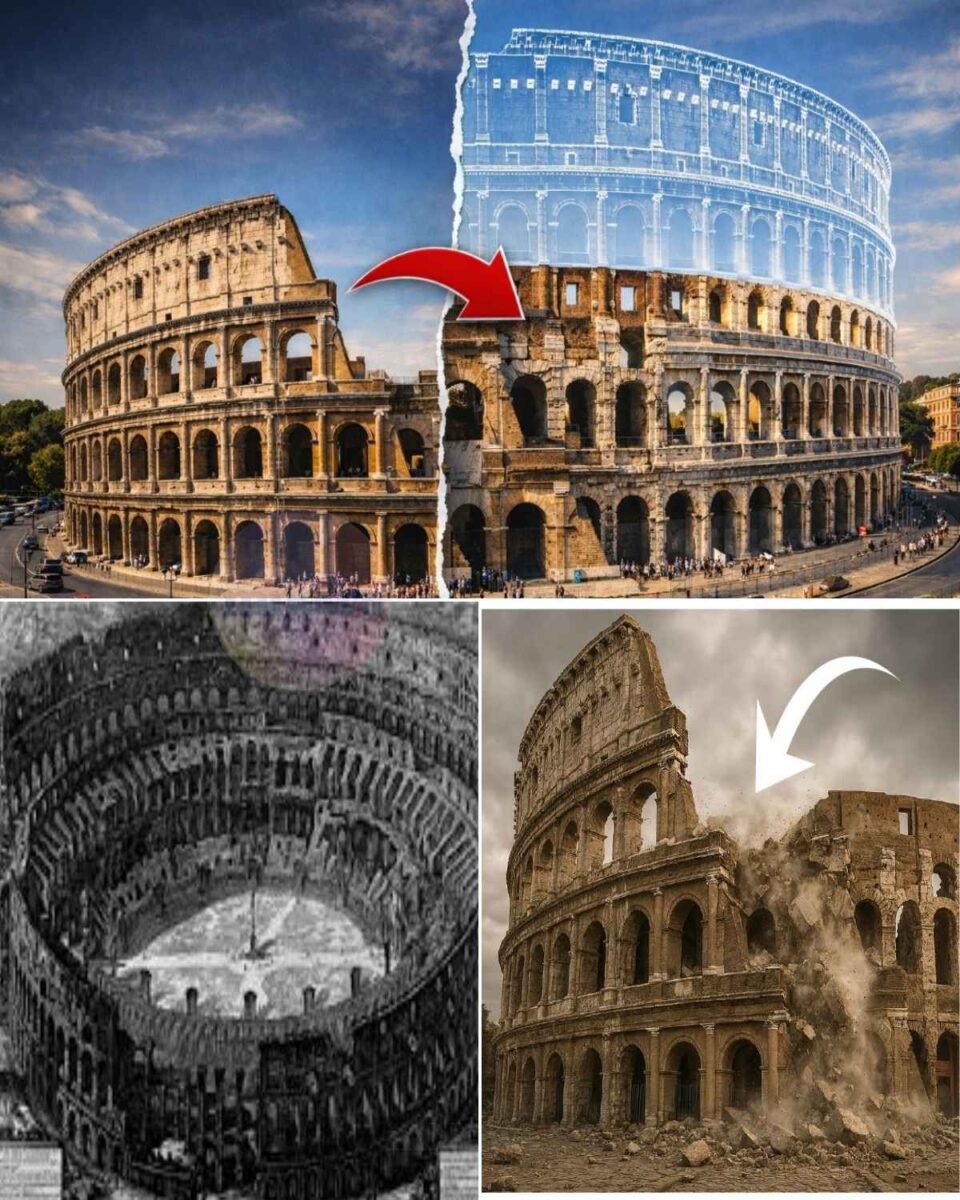
A jagged silhouette against the Roman sky, the Colosseum’s brutal absence of its southern flank has long confounded millions of visitors. This is not the gentle decay of time but a profound architectural wound, and its story is a two-thousand-year chronicle of disaster, theft, and survival that explains why this icon stands halved.
Completed in 80 AD under Emperor Titus, the amphitheater was a triumph of engineering and imperial power. Its smooth travertine facade gleamed, an imposing four-story oval that could hold 50,000 spectators for legendary gladiatorial games and spectacles. It was designed as an eternal symbol of Rome’s might, a perfectly symmetrical and seemingly indestructible machine for entertainment.

Centuries of relentless use and the fading focus of a struggling empire began to tell. The first major assaults came from nature. Rome sits in a seismically active region, and repeated earthquakes over centuries shook the massive stone structure. Each tremor widened cracks and shifted colossal blocks.
A critical vulnerability lay beneath the southern foundation, which was built on slightly less stable alluvial soil. This weakness meant that side absorbed disproportionate stress with every seismic event. The catastrophic blow landed in 1349 when a powerful earthquake finally caused a massive section of the southern outer wall to collapse outward.
The disaster created a new reality. Instead of viewing the fallen stones as a tragedy, medieval Romans saw a resource. The city entered a period where the ancient monument was systematically quarried. The valuable travertine blocks were carted away to build palaces, churches, and roads.
Workers even pried out the iron clamps that held the stones together, leaving the distinctive pockmarks visible today. Marble facades were burned in kilns to make lime. This organized looting continued for centuries, with the Colosseum supplying material for structures like St. Peter’s Basilica and the Palazzo Venezia.

The amphitheater’s identity transformed further in the Middle Ages. Its vast interior became a makeshift neighborhood, with workshops, houses, and even a church erected within the arena. Later, powerful families like the Frangipane fortified it as a castle, turning it into a stronghold for medieval power struggles.
By the Renaissance, the Colosseum was a perilous ruin, its fate seemingly sealed. The continued removal of structural stone made it increasingly unstable, and many believed it would vanish entirely. Its salvation arrived from an unexpected quarter: the Vatican.
In the 18th century, Pope Benedict XIV declared the site sacred, believing it to be a place where early Christian martyrs had perished. This ended centuries of legal quarrying. The Church installed Stations of the Cross and began essential stabilization work, viewing it as a monument to preserve, not a quarry to plunder.
What visitors see today on the southern side is not the original wall but the exposed internal skeleton—the intricate system of radial arches and corridors that always supported the seating. The collapse and subsequent stone theft simply stripped away the outer skin, revealing the brilliant engineering within.
Modern Rome now engages in a constant battle to preserve what remains. Teams of archaeologists and structural engineers work to mitigate damage from pollution, vibration, and time. The exposed southern side, while a scar, is meticulously monitored and supported, a permanent testament to the building’s turbulent history.
The missing side is therefore the cumulative result of a specific geological weakness, a devastating 14th-century earthquake, and hundreds of years of deliberate stone-robbing. It is a physical archive of Rome’s journey from ancient empire through the pragmatic Middle Ages to a guardian of its own legacy.
This iconic wound ensures the Colosseum is never seen as a sterile relic. It stands as a raw, open monument to resilience, having served as an arena, a fortress, a village, a quarry, and a shrine. Its fractured profile is the most powerful part of its narrative, a stark reminder that history is not merely preserved but is often carved away, leaving a silhouette of survival against the sky.