A long-simmering feud between two of hip-hop’s most formidable moguls has erupted into a new, and intensely personal public war, with Rick Ross launching a devastating attack targeting Birdman’s financial stability and loyalty. The clash, reignited amid the industry-shaking Drake and Kendrick Lamar conflict, has escalated beyond lyrical disses to a stark, real-world indictment of wealth and legacy.
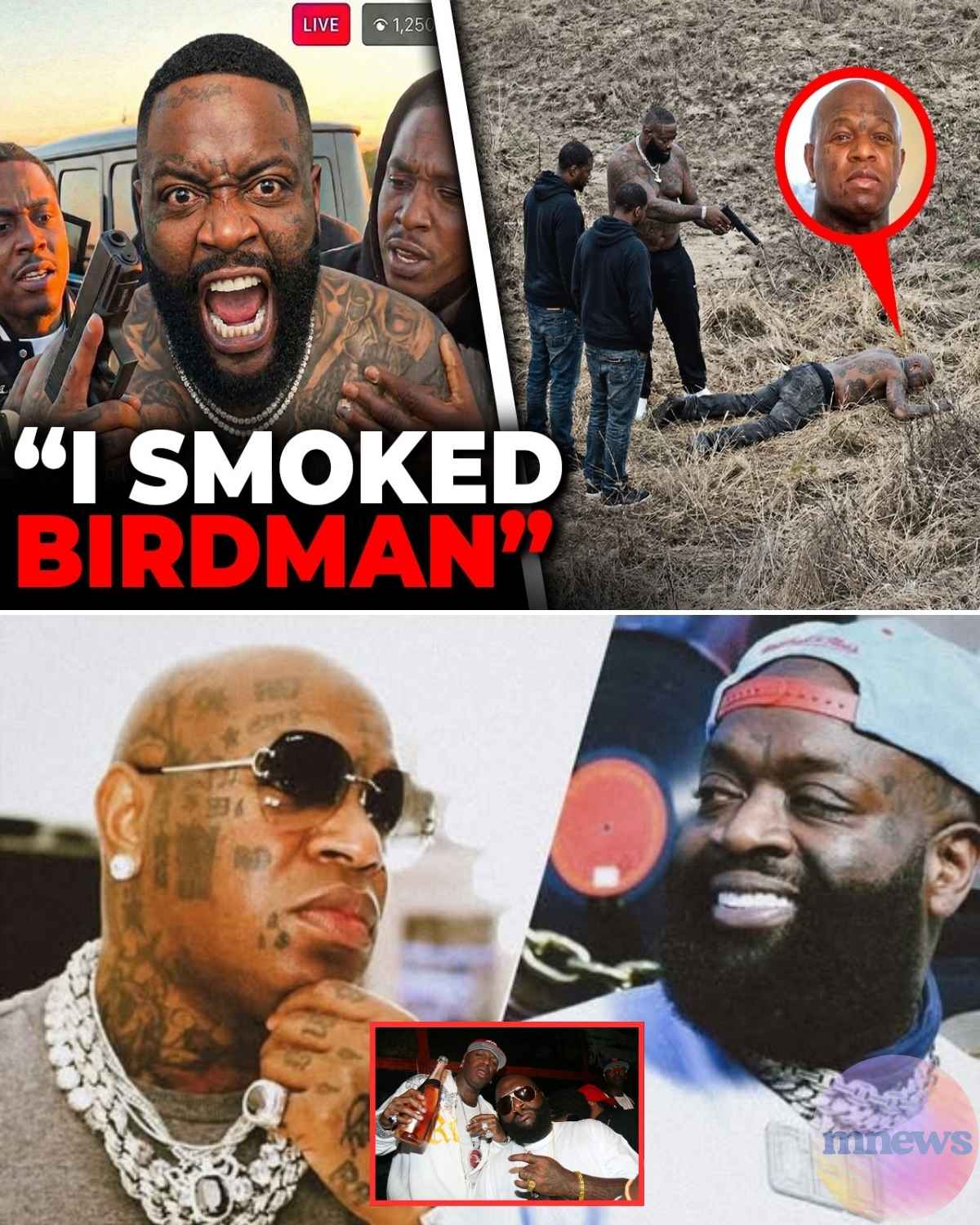
The latest salvo came from the deck of Rick Ross’s yacht in Miami. In a pointed Instagram Live video, Ross panned the camera toward the exclusive Star Island waterfront, directly referencing the foreclosure and loss of Birdman’s multi-million-dollar mansion there. “I saw you say that you got more money than Ricky Rose,” Ross declared, addressing Drake while implicating Birdman. “Your best friend, Birdman, has had his house go into foreclosure.”
This was not merely a taunt about past financial trouble. Ross framed it as a damning character assessment, challenging Drake’s proclaimed loyalty and Birdman’s curated image of boundless success. He set a mock 48-hour deadline for Drake to buy his mentor a new mansion, weaponizing a years-old property dispute into a fresh public humiliation. Birdman, who had days earlier posted an Instagram story pledging unwavering support for Drake with the caption “I’m riding with you 4L,” offered no public rebuttal.
This explosive moment is the culmination of a grudge that has festered for over a decade, transforming from industry tension into one of hip-hop’s most profound ideological battles. The core dispute centers on the very definition of executive power and ethical leadership within the music business. What began as a private rift has become a public referendum on exploitation, loyalty, and the moral responsibilities of a “boss.”
The origins of the schism trace back to 2015, far from the glittering Miami coast. Rick Ross, then embroiled in Meek Mill’s feud with Drake, released the track “Color Money.” A single line—”I got more money than the label you’re signed to”—was ostensibly aimed at Drake but landed as a direct challenge to Drake’s label head, Birdman, and the Cash Money empire. In a subsequent interview on The Breakfast Club, Ross stripped away all ambiguity about their relationship.
“What’s your relationship with Birdman?” host Charlamagne Tha God asked. “I don’t have one with Birdman,” Ross replied coolly. He then revealed the true source of his disdain was not business competition but a personal, moral observation. He cited watching the protracted and public contractual struggles of Lil Wayne, an artist he idolized, with Cash Money. “For me to see the way… things are transpiring, I can’t respect that,” Ross stated, framing Birdman’s treatment of his protégé as a fundamental failure.

Birdman consistently dismissed external commentary, framing his issues with Lil Wayne as a private family matter. “Whatever business me and him have, that’s my son,” Birdman asserted in interviews, constructing a wall of paternal language around the business dispute. This refusal to engage with the substance of Ross’s criticism only deepened the divide.
The cold war turned scorching on March 17, 2017, with the release of Ross’s album Rather You Than Me. The nearly six-minute track “Idols Become Rivals” was a slow, deliberate, and meticulously detailed prosecution. Over a somber beat, Ross abandoned his trademark swagger for a tone of solemn accusation, methodically building a case against Birdman’s practices.
The song accused Birdman of withholding publishing rights from artists and failing to pay producers like Mannie Fresh and Scott Storch. It invoked the imprisoned former Hot Boys members BG and Turk, suggesting they were abandoned by the label that built its name on their talent. The heart of the track was a direct plea concerning Lil Wayne: “I pray you find the kindness in your heart for Wayne / His entire life he gave you what there was to gain.”
Most shocking was the outro, which dragged DJ Khaled—a figure publicly synonymous with positivity and loyalty—into the fray. Ross alleged Birdman had left Khaled, a close friend, in a “financial hole” after his stint on Cash Money. This was a masterstroke, implying that even those who maintained public silence were secretly burdened by Birdman’s dealings.
Birdman’s initial response was characteristically dismissive. “I don’t get caught up in ho-ish,” he told Billboard, deflecting the song’s specific, grave allegations. “Numbers don’t lie and that’s all I give a f** about.” He pointed to commercial success as his sole metric and rebuttal. However, the track had achieved its objective: it permanently entered the record, a sourced and lyrical indictment that could not be unseen.
The fallout was telling. Lil Wayne tweeted his gratitude to Ross, writing the message “hit me in the heart.” DJ Khaled, on The Breakfast Club, praised Ross as “family” but addressed Birdman with careful, conditional language: “I hope that all that stuff gets fixed someday.” The industry at large, including major Cash Money alumni, maintained a strategic silence, a vacuum that amplified the resonance of Ross’s solitary accusations.

The feud entered a dormant phase after Wayne settled with Cash Money in 2018, but the underlying animosity never dissipated. In 2022, Birdman finally addressed it, not by confronting the accusations of “Idols Become Rivals,” but by attacking Ross’s originality. “Ross sits under me forever, stalking my style and peeping my sauce,” he claimed, reframing their history as one of a mentor and an imitator.
This set the stage for the 2024 escalation. When Birdman publicly aligned with Drake against Ross in the midst of rap’s largest feud, he provided Ross the perfect opportunity to synthesize all past grievances into one cutting, contemporary blow. The Star Island foreclosure video was that blow—a tangible symbol of financial overextension and failed image-making.
The conflict is rooted in the parallel paths of the two men. Brian “Birdman” Williams co-founded Cash Money Records in New Orleans, building a billion-dollar empire from the ground up with his brother Ronald “Slim” Williams. Their model of total ownership and control, exemplified by the iconic “bling” era and the careers of Lil Wayne, Drake, and Nicki Minaj, became a blueprint for hip-hop entrepreneurship.
William “Rick Ross” Roberts II studied that blueprint intently. Founding Maybach Music Group in 2009, he consciously modeled his boss persona and label structure on the Cash Money archetype, initially viewing Birdman with genuine admiration. Their closeness in Miami led to a collaborative 2013 mixtape, The H. But where Birdman saw a student, Ross was becoming a critic.
The crack that Ross witnessed—the lawsuits from Wayne, the whispers of unpaid debts, the plight of original Cash Money soldiers—contradicted the boss mythology he sought to emulate. His transformation from idolizer to accuser was born from this disillusionment. For Ross, a true boss protects and uplifts his family; in his view, Birdman had consumed his.
Thus, the foreclosure taunt is the ultimate metaphor in Ross’s argument. It is not just about a house; it is about the fragility of the image Birdman projects. It questions the very foundation of the empire: was it built on sustainable success or leveraged illusion? By daring Drake to buy the mansion, Ross challenges the depth of the loyalty Birdman commands from those he has championed.
As of now, the stalemate is absolute. Birdman maintains his strategy of silent, stoic dismissal, implying his continued business operations are rebuttal enough. Ross continues to wield narrative and public perception as his weapon. There is no indication of reconciliation, only the certainty that this feud, now over a decade old, remains a live wire in hip-hop.
It transcends personal animosity. The Birdman and Rick Ross beef is a foundational debate about power, accountability, and legacy in a multi-billion-dollar industry. One man built an empire that changed music forever. The other, who once worshipped that empire, now seeks to define its legacy not by its peaks, but by what he alleges was left broken in its wake. The war is not for charts or sales, but for history itself.