In a stunning revelation that upends decades of scientific assumptions, researchers have decoded the complete, uncontaminated DNA of Ötzi the Iceman, exposing a radically different ancestry and appearance than previously believed. This breakthrough dismantles long-held theories about prehistoric Europe’s genetic history and rewrites the story of this 5,000-year-old frozen man.
Discovered in 1991 in the Alps, Ötzi stunned the world as the oldest intact human mummy, frozen for over five millennia. His preservation provided an extraordinary window into Copper Age life — from his clothing to his tools, every detail told a story of survival in brutal mountain conditions. Yet, it is his DNA that now delivers the most earthshaking insight.
Initially, Ötzi was thought to be a genetic bridge between ancient Europeans and later migrating Indo-European peoples. Early DNA sequencing in 2012 suggested he carried steppe ancestry, challenging timelines about when these populations arrived in Europe. This finding dominated discussions for over a decade, reshaping understandings of prehistoric migration.
However, the cutting-edge genetic analysis completed in 2023 demolished this narrative entirely. Using advanced contamination-prevention methods, scientists sequenced Ötzi’s genome from his hip bone, a sample far less prone to modern DNA interference. The results revealed the prior steppe ancestry evidence was a contamination artifact—never present in Ötzi’s true genetic makeup.
Instead, Ötzi’s unprecedented new genetic profile shows that over 92% of his ancestry originated from Neolithic Anatolian farmers who migrated from the region of modern-day Turkey around 8,000 years ago. This population was pivotal, introducing agriculture and radically transforming European societies. The remaining ancestry came from Europe’s indigenous hunter-gatherers, forming a unique isolated genetic mixture.
This profound discovery uncovers an isolated community surviving high in alpine valleys, separated by rugged terrain and cultural barriers. Unlike other European populations, Ötzi’s lineage avoided later mixing with migrating groups, preserving a near-pure snapshot of a nearly lost genetic heritage. His people’s survival strategy ultimately led to genetic bottlenecks increasing vulnerabilities to disease.
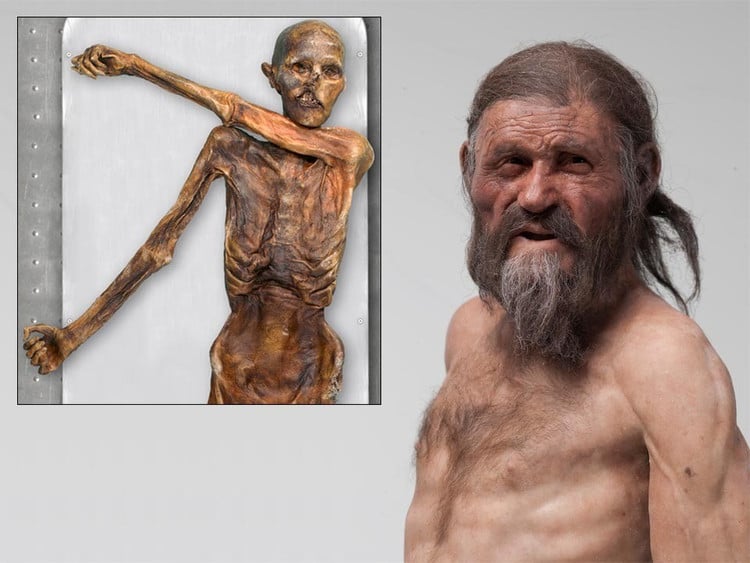
One of the most jarring revisions is Ötzi’s appearance. Prevailing reconstructions depicted him with pale skin, light eyes, and thick brown hair, reflective of early, limited DNA results. The updated analysis shows he had dark skin, deep brown eyes, and was balding—an appearance radically different from previous assumptions, challenging simplistic views of ancient European traits.
These revelations shake the foundation of how historians, archaeologists, and geneticists visualize early European populations. They emphasize ancient Europe’s genetic diversity and complexity and highlight the dangers of early DNA analyses susceptible to contamination. They underscore scientific rigor’s critical role in unearthing accurate histories.
Ötzi’s body also reveals an agonizingly human story marked by chronic illnesses that mirror some of today’s modern ailments. Genetic predispositions to heart disease, type 2 diabetes, arthritis, and lactose intolerance were identified. His remains showed infections, parasites, and painful tattoos placed deliberately on joints, interpreted as therapeutic marks for pain relief—early evidence of medical practices.
The man once seen as a robust hunter now emerges as a figure burdened by suffering and physical decline caused by harsh living conditions and genetic isolation. His final days were marked by a violent struggle. An arrowhead lodged in his shoulder caused fatal bleeding, confirming he was likely ambushed or attacked amid high mountain tensions.
Ötzi’s tattoos, initially dismissed as random marks, have been reexamined and reveal carefully placed patterns aligning with acupuncture points, suggesting sophisticated pain management techniques far preceding known historical records. Pigments in his tattoos contain microscopic medicinal herbs, indicating possible trade networks or long-distance travel by his community.
Perhaps most dramatically, Ötzi’s closest living genetic relatives reside not near the Alps but on the island of Sardinia, known for retaining ancient Neolithic farmer ancestry due to geographical isolation. This astonishing fact repositions Ötzi as a genetic dead end, representing a vanished branch of humanity whose legacy survives only in isolated pockets.
The reinterpretation of Ötzi’s ancestry and appearance is a profound reminder of the ever-evolving nature of scientific knowledge. It exposes how cultural biases and incomplete data once shaped historical narratives. Now, armed with advanced genomics, scientists rewrite the prehistoric European story with clarity, honesty, and complexity.
Ötzi’s revised portrait is not merely a historical curiosity; it resonates as a testament to human
endurance, vulnerability, and adaptability. He embodies a lineage almost lost to time and a population that once transformed Europe’s destiny through the advent of farming and settled life, yet paradoxically perished or diluted in the millennia that followed.
This breakthrough overturns a decade of accepted wisdom and redefines the legacy of the Copper Age’s most famous figure. Ötzi is no longer a genetic bridge between distant Eurasian peoples but rather a fascinating emblem of isolation and survival in a harsh prehistoric world, frozen in ice yet alive through science’s relentless pursuit of truth.
As genomic technologies continue to advance, more discoveries like Ötzi’s updated story are expected, further revealing the tangled, rich mosaic of humanity’s past. This case stands as a cautionary tale on the necessity of methodical, contamination-free research in ancient DNA studies—critical for reconstructing humanity’s vast and complicated heritage accurately.
The Iceman’s final hours tell a story of attack, suffering, and endurance, frozen forever in icy silence until science unlocked the truth. His body and DNA together provide a unique intersection of biology, archaeology, and history, illuminating how humans thousands of years ago lived, died, and faced challenges strikingly familiar to modern humanity.
Ötzi’s changing narrative highlights the intersection of technology and archaeology, emphasizing how each innovation reshapes our understanding of the past. This genetic revelation is not just a correction—it is a revolution that demands historians and scientists reconsider the deepest assumptions about ancient European migrations and appearances.
Ultimately, the tale of Ötzi the Iceman is a profound human story, shattered myths, and a beacon for scientific rigor. From the Alps’ icy reaches, his legacy now challenges us to embrace complexity over simplicity and to respect the patience and precision necessary for uncovering history’s truest face.