A political earthquake has shaken the House of Commons as the Labour government’s flagship welfare reform bill lies in tatters following a brutal and humiliating parliamentary defeat. Prime Minister Keir Starmer was left visibly rattled during a fiery Prime Minister’s Questions session, facing a forensic dismantling of his authority from Opposition Leader Kemi Badenoch that laid bare a government in profound disarray.
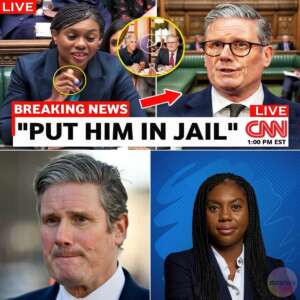
The session erupted into chaos as Badenoch exposed the core reality of the previous night’s events: the government’s own backbenchers had forced a dramatic U-turn, gutting a key clause from the Welfare Reform Bill. The legislation, originally touted as a cost-saving measure to get people back to work, was left neutered and is now projected to cost the Treasury millions. Chancellor Rachel Reeves was seen fighting back tears on the front bench as the scale of the political disaster became apparent.
Badenoch seized on the prime minister’s evident weakness, demanding to know how much the eviscerated bill would now save. Starmer’s response, focusing on principles and ending mandatory reassessments for the severely disabled, was met with derision. “I don’t think the prime minister actually watched what happened in the House yesterday,” Badenoch fired back. “His bill was completely gutted. This is the first prime minister in history to propose a bill to save money, who ended up with a bill that costs money.”

The clash laid bare a government losing control of its own agenda and its parliamentary party. Badenoch revealed that over a hundred Labour MPs had signed the rebel amendment that forced the climbdown, a stunning rebuke to Starmer’s leadership just one year into his premiership. “The reason he can’t answer the question is that he knows it doesn’t save any money,” she stated, branding the prime minister “too weak to get anything done.”
Starmer’s attempts to rally, listing first-year achievements like free breakfast clubs and NHS appointments, were drowned out by the escalating fury. The prime minister accused the previous government of breaking the welfare system, the NHS, and the economy, a line that met with loud jeers. “They broke everything that they touched,” Starmer declared, but the attack failed to land as the focus remained squarely on his government’s immediate crisis.
The opposition leader delivered the most damning indictment, linking the welfare fiasco directly to the economic fears of households. She revealed that since the election, an additional 1,000 people a day are signing on to incapacity benefits, a 50% increase, with sickness benefits alone now projected to rise to £100 billion. “He cannot reduce that now,” Badenoch stated, highlighting how the U-turn had locked in soaring future expenditure.
The session reached a fever pitch as Badenoch turned to the looming Autumn Budget, demanding Starmer rule out tax rises to pay for what she called the government’s “incompetence.” Starmer refused, adhering to the convention that chancellors do not pre-empt fiscal statements, but the damage was done. The exchange cemented the narrative of a government with no coherent plan, scrambling to cover a fiscal black hole it claims was inherited but is now dramatically widening.
The political fallout is immediate and severe. The Prime Minister’s Questions showdown was not merely a bad performance but a public evisceration of Labour’s core claim to competent, disciplined governance. With his own MPs describing the government as “incoherent and shambolic” on the record, Starmer’s authority is deeply wounded. The welfare bill, a key plank of Labour’s pledge to control spending and reform the state, is now a symbol of catastrophic retreat.
As the chamber erupted in partisan fury, the image of a beleaguered prime minister and a tearful chancellor signaled a profound shift in the political weather. The government’s agenda is in paralysis, its parliamentary discipline shattered, and its economic credibility questioned at the highest level. These PMQs will be remembered not as a clash but as a capitulation, a defining moment where Labour’s promise of stable change collided with the reality of chaotic and weak leadership. The road to the next election now looks dramatically different, and for Sir Keir Starmer, the path has become infinitely more difficult.