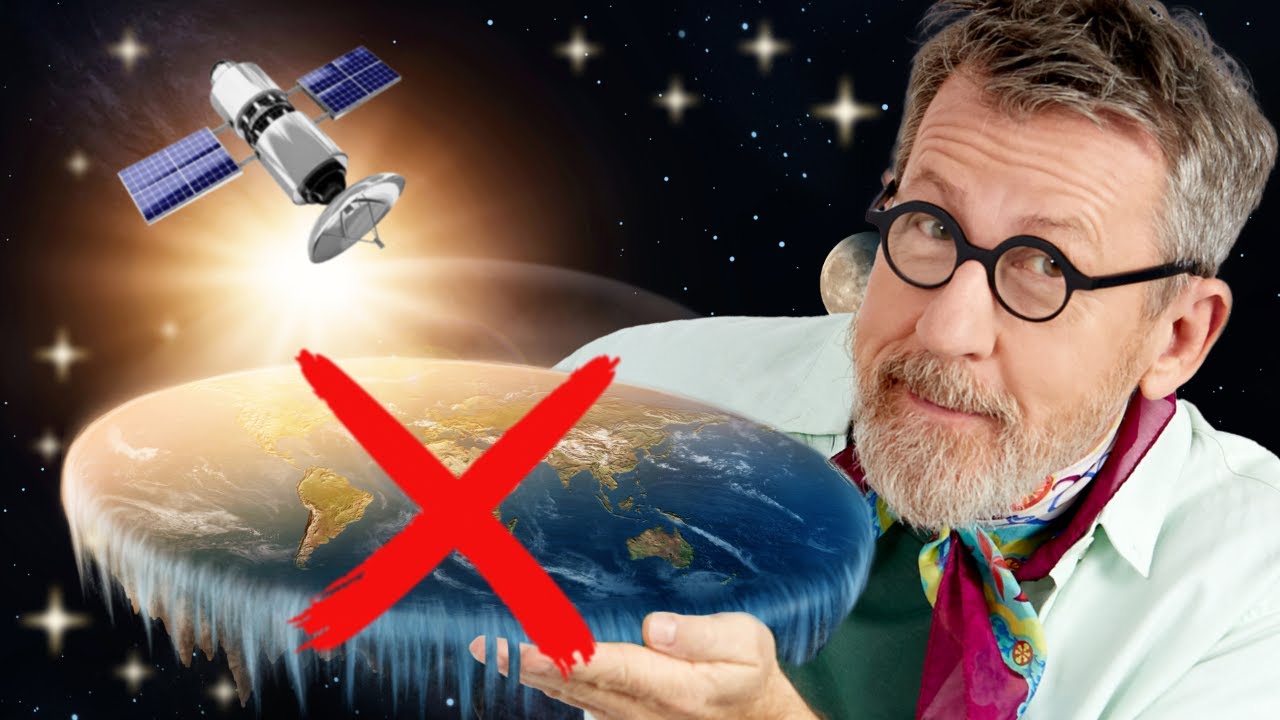
The evidence has been mounting for millennia, but in an age of digital misinformation, the fundamental shape of our planet has become a contentious topic. A new viral video, presented in the style of a French educational rap breakdown by artist Orelsan, has reignited the global conversation, systematically dismantling the flat Earth theory with a series of irrefutable, observable proofs that anyone can verify. The video, which has amassed millions of views in its first hours online, serves as a stark reminder that despite the tragic death of a flat Earth proponent in a homemade rocket in 2020, the debate over our planet’s geometry is far from settled, demanding a clear, evidence-based response from the scientific community.
The video begins by grounding its argument in ancient history, citing the Greek mathematician Pythagoras who, five centuries before Christ, first hypothesized a spherical Earth. This was not a modern invention but a theory rooted in early philosophical observation. The video then pivots to the first empirical proof, attributed to the scholar Eratosthenes over three centuries before the common era. He conducted a simple yet brilliant experiment involving two sticks planted at distant locations, one in Alexandria and another in Syene. By measuring their shadows at the same moment, Eratosthenes discovered a discrepancy. If the Earth were flat, the shadows would have been identical. The fact that the shadow in Alexandria was longer could only be explained by the curvature of the Earth, a foundational observation that has withstood two thousand years of scrutiny.
The video does not shy away from addressing the modern flat Earth movement, acknowledging the tragic death of Mike Hughes in 2020. Hughes perished while piloting a steam-powered rocket he built in his garage, attempting to reach an altitude of 1,500 feet to photograph the Earth and prove it was flat. The video notes that most flat-earthers are more grounded in their approach, but their arguments often rely on a misunderstanding of fundamental physics. One common claim is that if the Earth were round, inhabitants of the southern hemisphere would be upside down and fall into the void. The video swiftly counters this by introducing the concept of gravity, a force that pulls all objects toward the center of the Earth, ensuring that feet stay planted on the ground regardless of location on the globe.
To illustrate the necessity of a spherical Earth for consistent gravity, the video employs a thought experiment. It asks viewers to imagine a flat, disc-shaped planet, comparing it to a vinyl record. If a plumb line were suspended above such a disc, the center of gravity would be at the disc’s center. This would cause the plumb line to lean at different angles depending on its position on the disc, becoming increasingly tilted as one moved away from the center. The video argues that this would force humans, trees, and monuments to live in a perpetual state of leaning, a phenomenon that is clearly not observed in reality. Because the Earth is a sphere, every point on its surface is equidistant from its center, allowing gravity to act perpendicular to the ground, enabling upright posture and vertical falls.
The video credits the physicist Isaac Newton with bringing this gravitational understanding to light in the 17th century, a revelation famously inspired by a falling apple. The second major piece of evidence presented is attributed to the Greek philosopher Aristotle, who observed a lunar eclipse three and a half centuries before Christ. During a lunar eclipse, the Earth passes directly between the Sun and the Moon, casting its shadow on the lunar surface. Aristotle noted that this shadow was consistently rounded, an arc that could only be produced by a spherical object. The video emphasizes that if the Earth were flat, the shadow would appear as a straight line or a different shape, a phenomenon that has never been observed in recorded history.
Another simple, everyday observation is offered as proof: the behavior of ships sailing away from the coast. As a vessel moves toward the open sea, it does not simply shrink until it becomes a tiny dot. Instead, the hull disappears first, followed by the mast, as if the ship is sinking over the horizon. The video explains that this is not a matter of visual acuity or the limitations of telescopes. For an average-sized person, the curvature of the Earth limits the horizon to about five kilometers. The ship is literally hidden by the planet’s curve, with the front of the vessel disappearing first, a phenomenon that would be impossible on a flat plane where a powerful telescope could track it indefinitely.
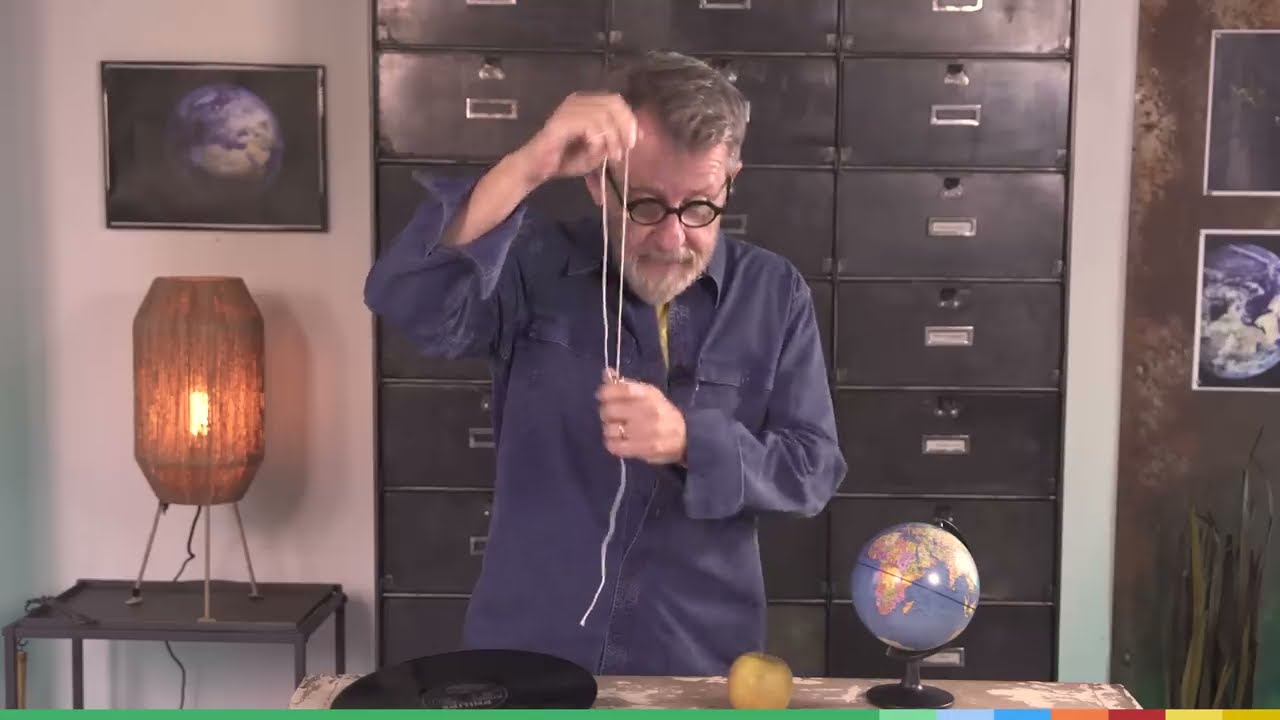
The video then tackles the issue of time zones, a daily reality that is inexplicable on a flat Earth. It uses a lamp to represent the Sun and a flat map to illustrate the problem. If the Earth were flat, the entire planet would be illuminated at the same time. While the Sun might appear higher or lower in the sky depending on location, as soon as it crossed the horizon, it would be daylight everywhere simultaneously. The video points out the logical impossibility of this, contrasting it with the real world where it is 9 AM in Paris and daylight, while it is only 4 AM in New York and still dark. A few hours later, it is 6 PM in New York and still light, while it is 11 PM in Paris and dark. This alternating cycle of day and night across different longitudes proves that the Earth rotates on its axis, completing a full turn every 24 hours, and that it is a sphere.
For those who remain skeptical, the video offers a final, observational challenge. It invites viewers to look up at the night sky with a telescope and point it toward Mars or Saturn. What they will see are round planets, just like all other known planets in the universe. The video anticipates the counter-argument that these might be discs, not spheres, and instructs viewers to continue their observation. As they watch, they will notice details moving across the surface, appearing on one side and disappearing on the other. This is clear proof of a spherical, rotating body. The video then poses a simple, logical question: if all neighboring planets are spherical, why would Earth be any different? This argument from consistency is a powerful one.
The video concludes with what it calls the ultimate proof, a flourish of modern science. It points to the famous photograph taken by the Apollo 17 mission in 1972, the first image of the entire Earth captured from outer space. Nicknamed the Blue Marble, this photograph shows a beautiful, round planet suspended in the blackness of space. The video states that there is no doubt left after seeing this image. It is a direct visual confirmation of everything the ancient Greeks hypothesized and proved through geometry and observation. The video ends with a call to action, urging viewers to subscribe to the channel and join a community of curious people who seek to understand the world through evidence and reason.
The video’s release comes at a time when scientific literacy is under constant assault from online echo chambers and conspiracy theories. The flat Earth movement, while small, represents a broader trend of distrust in established institutions, including science. The video’s approach is notable for its calm, methodical, and educational tone, avoiding mockery in favor of clear explanation. It provides a toolkit of arguments that anyone can use, from the simple observation of a ship’s hull disappearing over the horizon to the complex physics of gravity and planetary motion. The inclusion of the tragic death of Mike Hughes serves as a sobering reminder of the real-world consequences of rejecting established science.
The response from the scientific community has been one of cautious approval. Many researchers have praised the video for its accessible presentation of complex ideas. Dr. Emily Carter, an astrophysicist at the University of California, Berkeley, stated that the video is a masterclass in science communication. It takes concepts that can seem abstract and makes them tangible, using everyday objects like sticks, lamps, and plumb lines to demonstrate principles that have been understood for centuries. She noted that the video’s strength lies in its reliance on observations that anyone can make themselves, empowering viewers to become active participants in the scientific process rather than passive recipients of information.
However, the video has also drawn criticism from some corners of the flat Earth community. A spokesperson for a prominent flat Earth society issued a statement claiming that the video is a piece of propaganda designed to maintain the status quo. They argued that the photographs from space are faked and that the observations of ships and shadows can be explained by alternative models of perspective and atmospheric refraction. The spokesperson refused to engage with the video’s core arguments about gravity and time zones, instead repeating claims that the Earth is a stationary plane covered by a dome. This refusal to engage with evidence is a hallmark of the movement, making it difficult to have a productive dialogue.
Despite the pushback, the video’s impact is undeniable. It has sparked a new wave of interest in basic astronomy and physics, with search queries for Eratosthenes and lunar eclipses spiking dramatically. Schools and educators are already incorporating the video into their lesson plans, using it as a springboard for discussions about the scientific method, critical thinking, and the importance of evidence. The video serves as a powerful counter-narrative to the tide of misinformation, showing that the truth about our planet is not a matter of opinion but of observable, testable fact. It is a reminder that the Earth is not flat, and that the evidence for its roundness is all around us, waiting to be seen.
The video’s success also highlights a shift in how scientific information is being disseminated. In an era where traditional media is often distrusted, content creators on platforms like YouTube are becoming primary sources of education for millions of people. The video’s format, which blends music, animation, and clear narration, is highly effective at holding attention and conveying complex information. It is a model for how to fight misinformation, not by shouting down opponents, but by presenting a compelling, evidence-based case that empowers viewers to think for themselves. The video ends on a hopeful note, inviting viewers to join a community of learners, a stark contrast to the isolation of conspiracy theories.
As the video continues to circulate, it is sparking conversations in living rooms, classrooms, and online forums around the world. People are being asked to look at the world around them with new eyes, to question their assumptions, and to demand evidence. The video’s central message is that the shape of the Earth is not a mystery. It is a settled fact, supported by thousands of years of observation and experimentation. The video is a call to reason, a plea for people to trust their own eyes and the collective wisdom of the scientific community. It is a reminder that in the quest for truth, the evidence is always there, if we are willing to look.