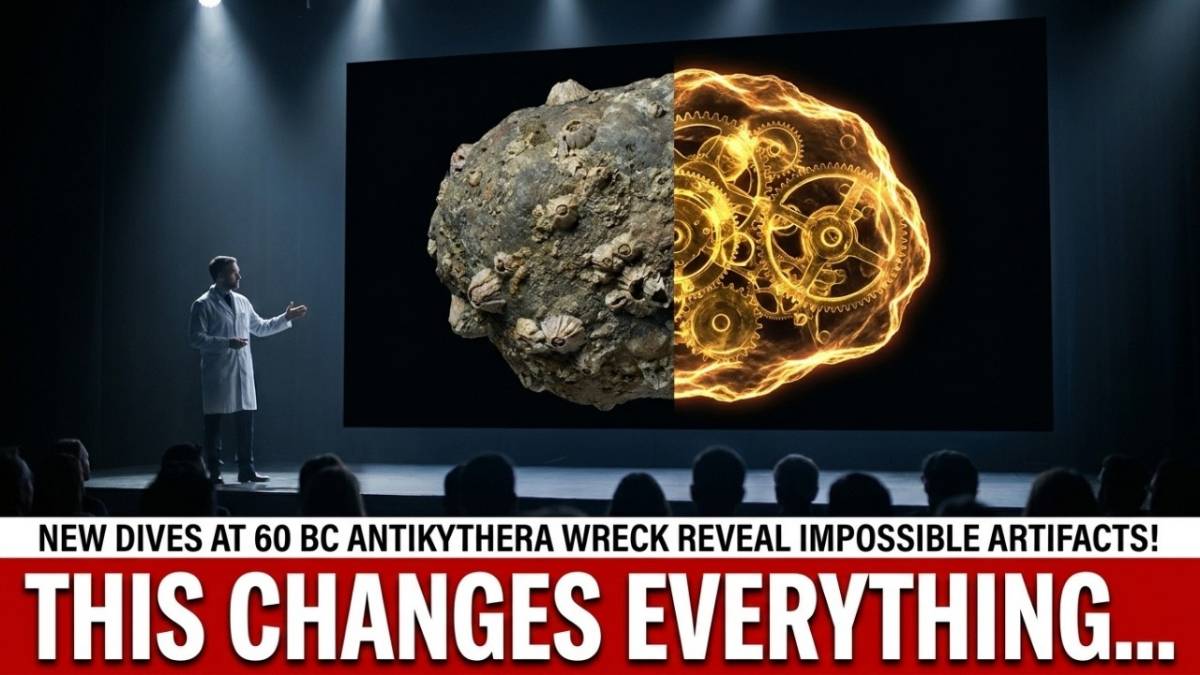
In a groundbreaking underwater excavation in 2024, archaeologists revisited the Antikythera shipwreck, revealing astonishing new finds far surpassing the famed ancient Antikythera Mechanism. Utilizing cutting-edge exosuit technology, teams uncovered a vastly larger wreck site, additional debris fields, and unclassified artifacts pointing to unprecedented ancient technological achievements.
 The Antikythera shipwreck, first discovered in 1900 by Greek sponge divers, stunned the world with its cargo of exquisite Hellenistic statues and the enigmatic Antikythera Mechanism. For over a century, the mechanism—a complex astronomical calculator—was hailed as the lone marvel from the wreck. That narrative is now shifting dramatically.
The 2024 excavation employed state-of-the-art exosuits, allowing archaeologists unprecedented hours of hands-on work at depths deadly to earlier divers. This advancement revolutionized underwater archaeology, facilitating a meticulous survey and recovery process that has unearthed treasure troves never before accessible.
Initial analysis confirms that the ancient Roman cargo ship was substantially larger than previously believed, measuring 40 to 50 meters long. This increase places it among the largest merchant vessels of its era, indicating a massive, highly valuable cargo destined for elite Roman patrons or as war loot from Greece.
Significantly, researchers identified a separate second debris field, located away from the primary wreck site, suggesting the ship fragmented upon sinking. This dispersed debris has yet to be fully excavated, holding potential for more explosive discoveries beyond the main wreck’s known artifacts.
Among the recovered items are numerous new bronze fragments, potentially belonging to statues hitherto unknown. These finds expand the wreck’s artistic cache and hint at the magnitude and richness of the ship’s original contents, which included priceless masterpieces of Greek art.
Perhaps most intriguing are artifacts currently undergoing detailed analysis due to their unrecognizable nature. Unlike familiar coins, amphorae, and statues, these objects defy classification, suggesting they may represent unknown forms of ancient technology or craftsmanship previously unseen in the archaeological record.
This cautious language from the research team has ignited speculation among experts: could there have been more than one Antikythera Mechanism aboard? The presence of multiple sophisticated mechanical devices would rewrite history, revealing a lost tradition of ancient scientific engineering far exceeding current understanding.

The Antikythera Mechanism discovered in 1902 was a solitary anomaly—a 2,000-year-old analog computer that predicted celestial events with astonishing precision. The possibility of additional mechanisms challenges the long-held view of its uniqueness and hints at widespread technological mastery in antiquity.
The wreck is situated off Antikythera Island, a notorious maritime graveyard of ancient vessels navigating treacherous currents between Crete and mainland Greece. The ship’s destruction around 60 BC coincides with Rome’s brutal conquest of Greece, adding a violent historical backdrop to this remarkable cargo.
Recovered artifacts date from that period, including Rhodian and Coan wine amphorae and Roman coins, reinforcing the timeline of the ship’s final voyage amid the geopolitical upheaval following the sack of Athens by General Sulla in 86 BC.
This historical context supports theories that the cargo represented plundered treasures from Greek cities, destined as war booty for Rome’s elite. Alternatively, the shipment may have been a collector’s private hoard. Either scenario underscores the ship’s significance and the extraordinary wealth it carried.
Early 20th-century excavation was heroic yet perilous. Using primitive helmet and hose diving gear, divers worked at deadly depths, suffering fatalities and permanent injuries. The operation ceased with much of the wreck untouched, laying the groundwork for future explorations enabled by modern technology.
Jacques Cousteau’s 1976 expeditions retrieved further artifacts but lacked systematic archaeological methods. It was not until the 2010s, with advanced equipment and robotics, that a comprehensive reassessment of the site began, uncovering a wider debris spread and numerous overlooked treasures.

The Return to Antikythera Project brought cutting-edge techniques, mapping the full wreck extent and introducing exosuits in 2014. These suits function as wearable submarines, enabling divers to work for hours at extreme depths without decompression hazards, thus transforming deep-water archaeology.
Among the dramatic recent discoveries is a life-size marble head of Hercules, confirming the presence of exceptional works still buried after the initial excavations. The finding underscores the incomplete nature of earlier digs and the deepened complexity of the site’s contents.
Human remains retrieved during recent digs have undergone DNA analysis, offering the first scientific glimpse into the identities of those aboard the vessel when tragedy struck. This new bioarchaeological data adds a poignant human dimension to the ship’s story two millennia later.
Every layer of investigation reveals new facets: the ship’s colossal scale, its fragmented wreckage fields, rich artistic treasures, and now these enigmatic artifacts requiring fresh study. Each element deepens the mystery and expands our understanding of ancient maritime commerce and culture.
While the research team remains cautious in public statements, the implication that some 2024 finds resist easy categorization has electrified expert circles. The possibility of uncovering multiple complex devices akin to the Antikythera Mechanism raises profound questions about the lost technological heritage of the ancient world.
If further analysis confirms additional mechanisms or analogous technological artifacts, it would herald the discovery of an engineering tradition of unprecedented sophistication, utterly rewriting narratives about the scientific capabilities of classical civilizations.

Over 124 years of combined exploration—from risky early dives to robotic surveys and atmospheric diving suits—the Antikythera wreck has steadily revealed secrets deeper than gold or statuary. Its story is a testament to human innovation, endurance, and the relentless pursuit of knowledge beneath the waves.
These recent breakthroughs not only challenge long-held assumptions but also highlight the vital role of evolving technology in archaeology. The exosuit’s success demonstrates how innovation continues to unlock hidden chapters of history previously sealed by ocean depth and time.
The joint Greek-Swiss collaboration exemplifies international dedication to uncovering and preserving cultural heritage. As the exhaustive analysis proceeds in labs in Athens and Geneva, anticipation builds over the full scope and implications of the newly unearthed artifacts.
Questions remain unanswered: Was the Antikythera Mechanism a singular marvel, or part of a broader, lost industry? What other technological wonders lie hidden beneath the seabed of Antikythera, awaiting discovery? And what does this tell us about the ancient world’s reach and intellect?
The 2024 season marks a pivotal chapter in the ongoing saga of the Antikythera shipwreck. As excavation continues and analyses deepen, scholars stand on the cusp of potentially rewriting technological history and redefining ancient civilization’s legacy.
For now, the maritime tomb off Antikythera holds its final cards close. But if past is prologue, the watery grave is poised to unveil revelations that could irrevocably alter our perception of antiquity, promising headline-making discoveries in the coming years.
This extraordinary story is far from over. The treasures, technology, and human lives wrought by the shipwreck continue to unfold in unprecedented detail, ensuring that the Antikythera shipwreck remains one of the most captivating archaeological mysteries of our time.
Source: YouTube