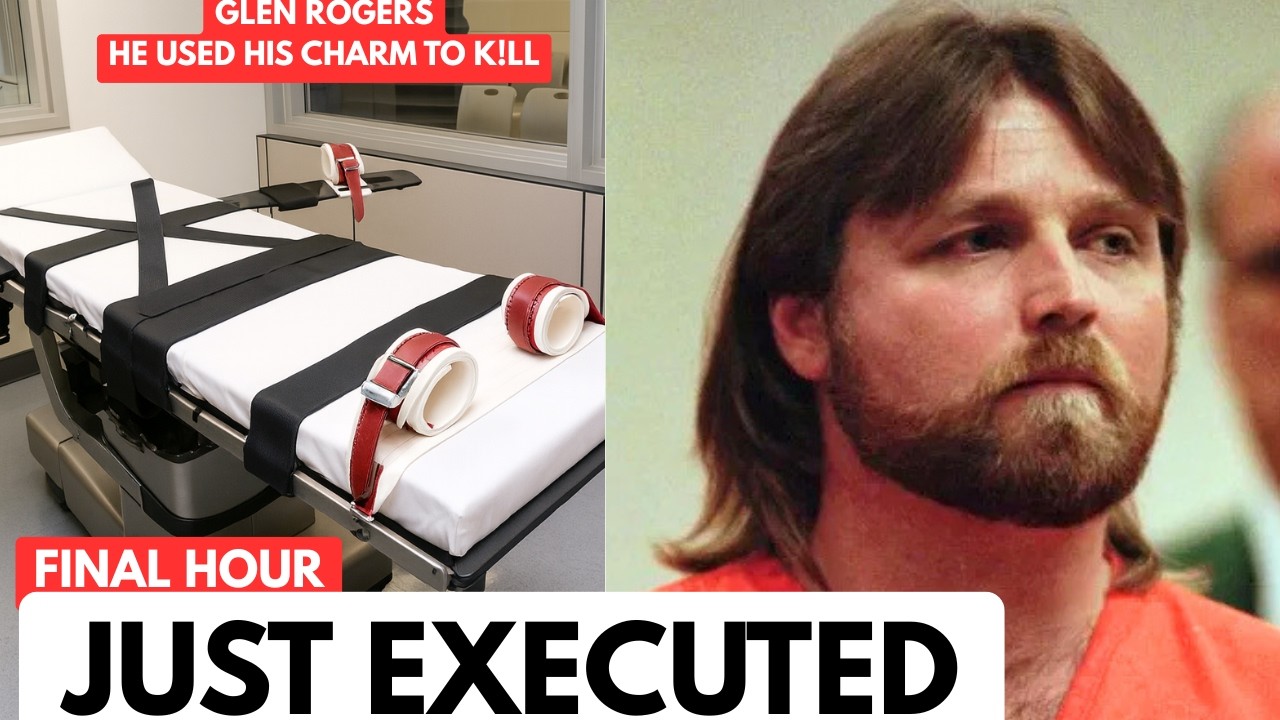
The state of Florida executed serial killer Glen Edward Rogers by lethal injection on Thursday evening, ending a nearly three-decade legal battle and a life marked by brutality, manipulation, and a final, cryptic message directed at President Donald Trump. Rogers, 62, was pronounced dead at 6:16 p.m. at Florida State Prison near Starke, becoming the fifth inmate executed in the state this year. His last words, spoken moments before the drugs took hold, promised unanswered questions would soon be resolved, offered a salute to the president, and declared he was ready to die.
Rogers’ execution concluded a spree that terrorized multiple states in the autumn of 1995, when he killed at least four women in six weeks. The victims, all single mothers in their 30s, were strangled, stabbed, or left to bleed out in bathtubs. Their families, many of whom waited 30 years for this moment, watched through the glass as the man who destroyed their lives took his final breath. For them, the closure was long overdue, but it came with a bitter edge of anger over his lack of remorse.
The condemned man’s final meal was simple: pizza, chocolate cake, and a soda. He ate it without fanfare, then spent his last hours inside the prison’s death watch unit. Earlier in the day, his brother Claude visited, separated by glass, and said goodbye. Claude later told reporters he asked God to guide his brother on the next journey. Rogers’ wife was his only other visitor, a quiet end to a life that had been anything but quiet.
Rogers was born on July 15, 1962, in Hamilton, Ohio, the youngest of seven children. His childhood was a catalog of horrors, with his mother Edna described as cruel, once holding his head underwater in a bathtub and nearly driving her children off a cliff. He struggled with ADHD and sleeping disorders, was expelled from junior high, and by 16 had fathered a child with a 14-year-old girlfriend. His marriage ended in divorce due to physical abuse, setting a pattern of violence that would define his life.
By his early 30s, Rogers had a criminal record for theft, pimping, assault, and multiple suicide attempts. He was tall, blonde, and green-eyed, with a charm that disarmed people, especially women with reddish hair who resembled his mother. But when he drank, the charm vanished, replaced by something darker. He was known to inject beer into his veins, a detail that speaks to his self-destructive nature and the chaos he carried inside.
In 1993, a 71-year-old retired electrician named Mark Peters took Rogers in, a fatal act of kindness. Peters vanished in October of that year, along with his car, antiques, guns, and coin collection. His remains were found months later in a cabin belonging to the Rogers family in Beattyville, Kentucky, bound to a chair and hidden under furniture. No charges were filed at the time, but the murder was a preview of the carnage to come.
The killing spree that made Rogers infamous began on September 28, 1995, in Van Nuys, California. Sandra Gallagher, a 33-year-old mother of three, met him at a bar and was found the next morning strangled in her truck, which had been set on fire. Her children were left without a mother. Rogers was already gone, drifting eastward, leaving a trail of bodies that would stretch from California to Louisiana.

In October, Rogers met Linda Price, a 34-year-old single mother of two, at the Mississippi State Fair. Her sister later recalled how Linda kept saying how good-looking he was. They shared an apartment briefly, but by Halloween, she was dead in her bathtub. Rogers had vanished again. The next victim was Tina Marie Cribbs, 34, a mother of two from Tampa, Florida. She was last seen leaving a bar with Rogers on November 5, 1995. Two days later, her body was found stabbed in a motel bathtub.
Rogers had checked into the motel, paid for an extra night, and asked that the room not be cleaned. He then drove off in Cribbs’ white Ford Festiva, heading north. Her wallet was later found at a rest area, fingerprints matching Rogers. The fourth victim, Andy Giles Sutton, was found dead on a punctured waterbed in her Bossier City, Louisiana apartment on November 9, 1995. She had been slashed. Rogers was already gone again.
By November 13, 1995, Rogers was on the FBI’s Ten Most Wanted list. A Kentucky State Police detective spotted him driving Cribbs’ stolen car and gave chase. A rookie officer joined, and a trooper set up a roadblock, firing a shotgun blast that hit the rear tires. A sergeant rammed his patrol car into the stolen vehicle, spinning Rogers into a ditch. He was pulled out and arrested, with a local TV crew filming the entire scene.
During the chase, Rogers had thrown an empty beer can at a police cruiser, a final act of defiance. After his arrest, he claimed to have committed nearly 70 murders, a boast he later dismissed as a joke. But the damage was done. He was convicted in Florida for Cribbs’ murder in 1997 and sentenced to death. In California, he was convicted for Gallagher’s murder in 1999 and also sentenced to death. He sat on death row for nearly three decades.
The controversy that followed Rogers into his grave involved one of the most famous murder cases in American history. In 2012, a documentary called My Brother, the Serial Killer, narrated by his brother Clay, claimed Rogers had confessed to killing Nicole Brown Simpson and Ron Goldman in 1994. Rogers allegedly told a criminal profiler that O.J. Simpson had hired him to steal jewelry and said, You may have to kill the bitch. The LAPD rejected the claim, and Fred Goldman, Ron’s father, called it baseless.
Rogers’ family said he had worked as a house painter for Nicole Brown Simpson in 1992, which they claimed was how they met. A 2019 film, The Murder of Nicole Brown Simpson, portrayed his version of events. But Los Angeles prosecutors found no credible link, and the families of both victims condemned the documentary. Whether Rogers was telling the truth or simply seeking infamy remains unknown, but it kept his name in the news for decades.
In his final appeals, Rogers argued he had suffered severe sexual abuse as a child, claiming recovered memories from 2019. He also alleged abuse at a juvenile detention facility in Ohio. The Florida Supreme Court rejected the argument, and Governor Ron DeSantis signed his death warrant on April 15, 2025. Rogers appealed to the U.S. Supreme Court, but was denied on May 14, the night before his execution.

On May 15, Rogers woke at 3:45 a.m. and had one visitor, his wife. His brother Claude had said goodbye the day before, separated by glass. Rogers spent his final hours inside the prison, eating his last meal of pizza, chocolate cake, and soda. At 6 p.m., the curtain parted in the execution chamber. Thirty witnesses watched as Rogers lay on a gurney, half-covered by a sheet. He was compliant, not resisting.
The three-drug lethal injection protocol included a sedative, a paralytic, and potassium acetate to stop the heart. At 6:16 p.m., Rogers was pronounced dead. Before the drugs took hold, he spoke his final words. I know there is a lot of questions that you need answers to, he said. I promise you in the near future the questions will be answered, and I hope in some way will bring you closure. President Trump, keep making America great. I am ready to go.
He thanked his wife and made a cryptic promise about questions that would be answered, without specifying which ones. Then he addressed the president, a final act of manipulation that left observers wondering if he was telling the truth or simply playing the room one last time. The families of his victims watched him die, some waiting 30 years for this moment.
Jerry Valacella, sister of Sandra Gallagher, said after the execution she would finally be able to rest. Debbie Sparks, sister of Linda Price, attended with her family and said they found closure, but she was angry that Rogers never showed remorse. Randy Roberson, son of Andy Giles Sutton, said the execution brought closure but felt it was too easy, too peaceful. Tina Cribbs’ mother had said years earlier, God is on my side. I hope he will remain on my side until I do see this done. She saw it done.
Rogers spent 62 years on earth, born into dysfunction and violence. He grew up angry, used charm as a weapon, and killed at least four women in six weeks. He sat on death row for nearly 30 years, making appeals, claiming new memories, and dropping cryptic hints about cases he may or may not have been involved in. At the end, he went out with a shout-out to the president and a promise of answers he never delivered.
The question that lingers is whether Rogers was telling the truth about any of it, or whether he was, to the very end, doing what he had always done, keeping people hooked, making himself the center of something bigger than he deserved to be. The families of his victims can finally exhale, but the mystery of what he knew, and what he took to his grave, remains unsolved.
Source: YouTube