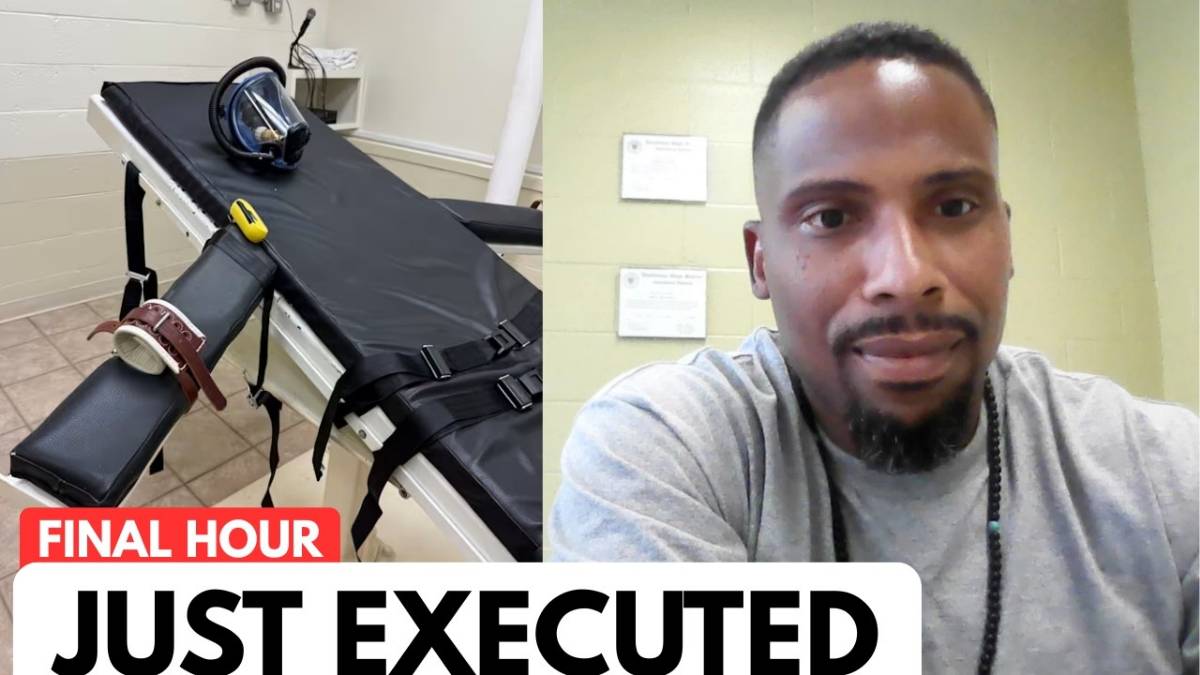
A Louisiana execution chamber fell silent Tuesday evening as the state carried out its first execution in 15 years, using the controversial method of nitrogen hypoxia to put to death Jesse Hoffman Jr. for the 1996 kidnapping, rape, and murder of 28-year-old advertising executive Mary “Molly” Elliott.
 Hoffman, 46, was pronounced dead at 6:50 p.m. at the Louisiana State Penitentiary in Angola. His death marks a grim resumption of capital punishment in a state that had not executed anyone since 2010 due to lethal injection drug shortages.
The execution proceeded after a narrow 5-4 ruling by the U.S. Supreme Court rejected final appeals. Hoffman’s legal team had argued the method constituted cruel and unusual punishment and violated his religious freedoms as a practicing Buddhist.
Witnesses described a process that began at 6:21 p.m. when nitrogen gas began flowing into a respirator mask secured to Hoffman’s face. Officials reported he was unconscious within seconds and clinically dead shortly thereafter.
His final moments were characterized by a profound silence. Hoffman declined to make a last statement when offered the chance at 6:20 p.m. He also refused a final meal, offering no last words or request.
The path to the execution chamber began on a Tuesday evening before Thanksgiving in 1996. Molly Elliott finished her workday in New Orleans and walked to the Sheraton parking garage, a routine she followed daily.
There, she encountered the 18-year-old valet, Jesse Hoffman Jr. He forced her into her car at gunpoint, made her withdraw money from an ATM, and drove her to a remote area of St. Tammany Parish where he raped and murdered her.
 Hoffman was arrested, convicted of first-degree murder in 1998, and sentenced to death. He arrived at Angola at age 19, where he would spend the next 26 years.
During his decades on death row, Hoffman underwent a profound transformation that became central to the controversy surrounding his execution. He embraced Buddhism in 2002, becoming a spiritual leader among the prison population.
His attorneys and supporters argued he was unrecognizable from the teenager who committed the crime. He became a father, with his son growing up visiting him behind glass.
“Louisiana executed a deeply loved man who brought light to those around him,” said defense attorney Caroline Tillman. “He spent nearly three decades proving people can change.”
The state, under Governor Jeff Landry, moved forward. A 2024 bill signed by Landry authorized nitrogen hypoxia as an alternative execution method after the long hiatus.
“If you commit heinous acts of violence in this state, it will cost you your life, plain and simple,” Landry stated following the execution.

The legal battle was fierce. Hoffman’s team cited disturbing witness accounts from prior nitrogen hypoxia executions and argued the method violated his Buddhist practice centered on controlled breathing.
Courts ultimately allowed the execution. In his final hours, Hoffman met with his Buddhist spiritual advisor, Reverend Raimoku Gregory Smith, who chanted as the process began.
Outside the prison, a familiar scene of protest and vigil unfolded. Hoffman’s sister wept near the gates, holding photographs. His son, Jesse Smith, had pleaded publicly for his father’s life days earlier.
Inside the witness chamber, observers reported Hoffman’s body shook and his hands clenched after the gas began flowing. Movement ceased approximately six minutes later.
A prison medical official stated Hoffman lost consciousness quickly and was clinically dead soon after. Louisiana officials declared the procedure “flawless.”
 The execution leaves a complex legacy for the victim’s family. Some members reportedly expressed that Hoffman’s death would not bring them peace, a sentiment common in long-delayed capital cases.
Molly Elliott, remembered as a bright, professional woman building her life in New Orleans, was denied any final words or meals. Her life ended in terror and violence nearly three decades ago.
Attorney General Liz Murrill signaled this execution is not an isolated event. She expects at least four more from Louisiana’s death row this year, where more than 55 people await execution.
The method itself remains under intense scrutiny. Nitrogen hypoxia, now legal in Louisiana and Alabama, has been used five times in U.S. history. Each use has drawn descriptions of physical distress from witnesses.
Hoffman’s death reignites enduring national debates about redemption, punishment, and the mechanisms of state-sanctioned death. It underscores a system that paused for practicality, not principle, and resumed with a new technique.
It also forces a confrontation with an uncomfortable question: Does profound, documented change over 26 years alter what justice requires, or does the sheer horror of the original crime render that transformation irrelevant?
The state of Louisiana has delivered its answer. At 6:50 p.m. on March 18, 2025, Jesse Hoffman Jr. breathed nitrogen until he could not. Molly Elliott, whose life was stolen at 28, remains forever silenced. The echoes of both their fates will resonate long after the chamber was cleared.
Source: YouTube