A Texas death chamber has claimed the life of a man whose crime and punishment ignited a national firestorm over justice, age, and the finality of the ultimate penalty. Napoleon Beazley, executed Tuesday evening by lethal injection, was 17 years old when he murdered a prominent businessman during a botched 1994 carjacking, a fact that placed his case at the heart of America’s debate on executing juvenile offenders.
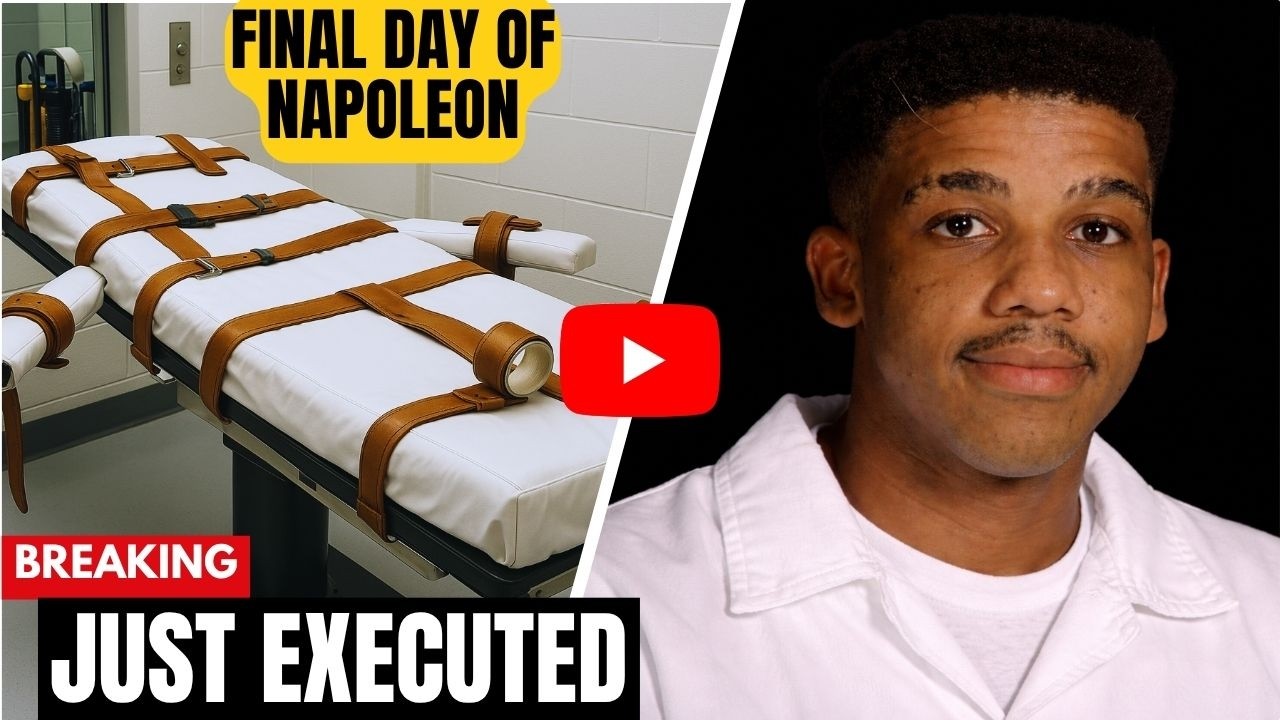
The 25-year-old was pronounced dead at 6:17 p.m. at the Huntsville Unit, his final appeals exhausted. His death closes a legal saga spanning eight years, marked by a stark contrast between his promising youth and a single night of devastating violence that forever altered multiple families.
The journey to this moment began on a quiet street in Tyler, Texas. Beazley and two accomplices targeted 63-year-old John Luttig and his wife Bobbie as they arrived home in their Mercedes-Benz. What was planned as a theft escalated into a point-blank shooting, with Beazley firing a .45 caliber handgun.
John Luttig was shot twice in the head and died instantly. Bobbie Luttig survived only by playing dead, lying motionless in terror as the assailants fled in the stolen car. The community was shattered, a grief compounded by the victim’s stature; his son, J. Michael Luttig, is a powerful federal appellate judge.
Investigators closed in swiftly. Accomplices Cedric and Donald Coleman cooperated, detailing the crime and identifying Beazley as the triggerman. Their testimony proved devastating at his 1995 trial, where prosecutors secured a capital murder conviction and a death sentence based on the brutality of the act and “future dangerousness.”

The defense pleaded for life, highlighting Beazley’s age, his previously exemplary record as a student leader and athlete, and his lack of a violent history. The jury, however, saw a planned, execution-style killing. His accomplices received lengthy prison terms; Beazley alone was sent to death row.
For years, Beazley’s case wound through appellate courts, gaining notoriety. On death row, he was described as a model inmate who expressed profound remorse. His youth at the time of the crime drew international condemnation and placed Texas’s laws under a microscope.
His final appeal reached a U.S. Supreme Court uniquely constrained by the crime’s legacy. Three justices recused themselves due to professional ties to the victim’s son, leaving only six to consider the case. They declined to intervene, clearing the path for the execution to proceed.
In his last hours, Beazley declined a special final meal. As he was strapped to the gurney, he delivered a lengthy, contemplative final statement that was both an apology and a critique of the system taking his life. He spoke with calm clarity to the witnesses assembled.
“The act I committed to put me here was not just heinous, it was senseless,” Beazley stated. “But the person who committed that act is no longer here. I am.” He assured officials he would not struggle, stating he would not “shout, use profanity, or make idle threats.”

His words then turned to a broader philosophical indictment. “I’m saddened by what is happening here tonight,” he continued. “I’m disappointed that a system that is supposed to protect and uphold what is just and right can be so much like me when I made the same shameful mistake.”
He expressed direct sorrow to the Luttig family. “I’m sorry that John Luttig died. And I’m sorry that it was something in me that caused all of this to happen to begin with.” Yet he framed the execution itself as a societal failure, a denial of second chances.
“If someone tried to dispose of everyone here for participating in this killing, I’d scream a resounding no,” Beazley said. “I’d tell them to give them all the gift that they would not give me… a second chance.” He concluded by asserting, “No one wins tonight. No one gets closure.”
Minutes later, the lethal injection was administered. His death arrived just three years before the Supreme Court’s landmark 2005 Roper v. Simmons decision, which ruled the execution of juvenile offenders unconstitutional. For Beazley, that evolving standard of decency came too late.
The case leaves a complex legacy: a family bereaved of a patriarch, a community haunted by violence, and a legal system forced to grapple with the culpability of a teenager who was both a star student and a cold-blooded killer. It underscores the enduring, divisive questions about redemption, retribution, and the point at which a young life becomes irredeemable in the eyes of the law.
In the quiet following the execution, the debates he cited rage on. His final words serve as a stark epitaph for a life that began with promise, descended into a moment of unforgivable violence, and ended as a focal point in America’s enduring struggle to define justice itself. The chamber in Huntsville is now silent, but the conversation he invoked continues unabated.
Source: YouTube