For over a decade, humanity’s most distant emissary has been reporting from a frontier no model predicted, revealing a solar system encased in a turbulent, pressurized wall of plasma. Data painstakingly recovered from the Voyager 1 probe, now over 15 billion miles from Earth, has fundamentally rewritten our understanding of where the sun’s influence ends and interstellar space begins.
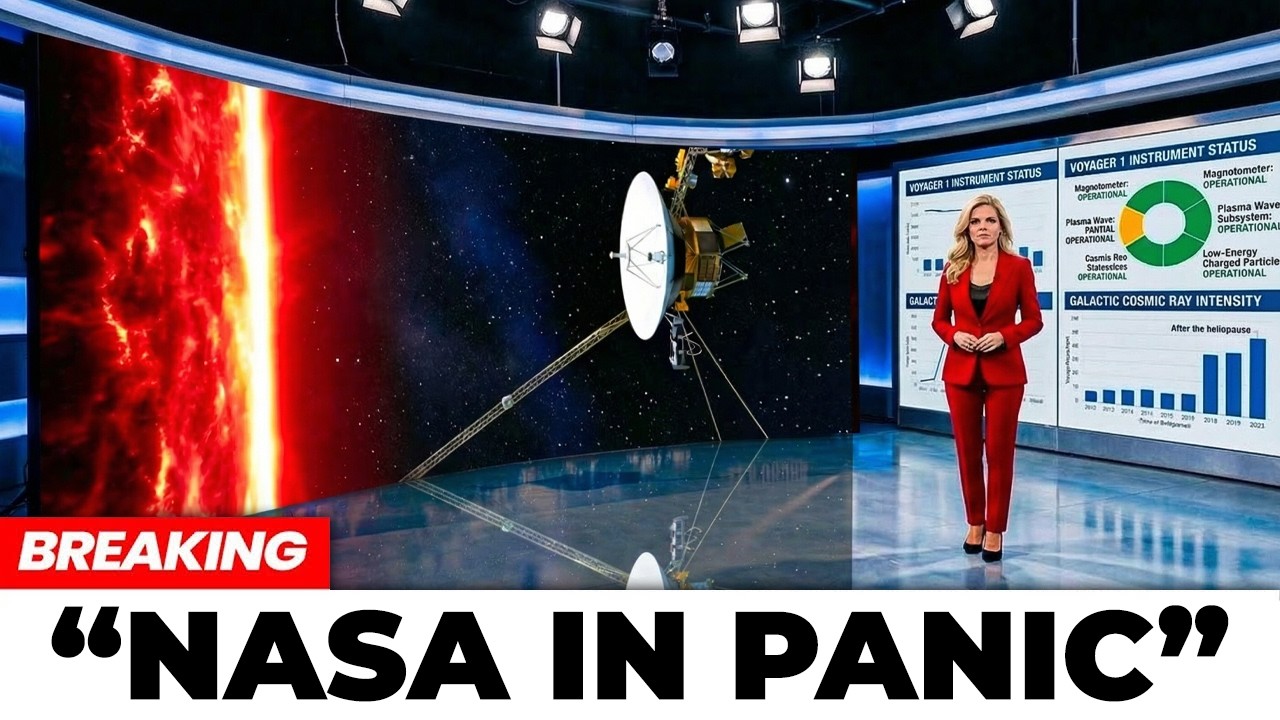
The revelation comes after a critical communications breakdown threatened to silence the spacecraft forever. Earlier this year, Voyager 1 began transmitting corrupted, unreadable data back to Earth, a seemingly fatal flaw for a machine operating without a repair crew and a 44-hour round-trip signal delay. Engineers at NASA’s Jet Propulsion Laboratory performed a remote technological miracle, restoring the data stream. What that restored signal contained was a scientific shock.
The readings described a boundary zone—the heliopause—that is not the quiet, fading edge scientists anticipated. Instead, Voyager found a violent, compressed region where the sun’s outward wind of particles slams into the inward flow of galactic material. This collision creates a dense, superheated wall of plasma, a turbulent frontier that behaves more like a churning storm front than a gentle dissolve into emptiness.
This discovery shatters a decades-old theoretical picture. Scientists long believed the heliosphere—the vast bubble of solar wind and magnetic fields encompassing our planetary system—simply thinned out into the interstellar void. The transition was expected to be smooth, a gradual dimming of solar influence. Voyager’s direct measurements tell a story of forceful collision and dynamic interaction.
The first clue emerged in 2012 when Voyager 1 initially crossed the heliopause. The drop in solar particles and surge in galactic cosmic rays was astonishingly abrupt, occurring over mere days. More unsettling was the magnetic field data. Instead of cleanly reorienting to the galaxy’s field, the magnetic direction remained tangled with the sun’s, indicating the two environments were fiercely intertwined at the boundary.

Voyager 2’s crossing in 2018, armed with a functioning plasma instrument, confirmed the finding. It measured a thin, fluctuating membrane of plasma, a definitive pressure front. Further analysis of years of data revealed even greater strangeness. The interstellar plasma density beyond the wall is higher than predicted and increasing as the probes travel farther out.
Perhaps most strikingly, Voyager detected shockwaves from ancient solar storms that had crossed the boundary and were still propagating through interstellar space. This proved the frontier is permeable, a site of constant energy exchange between the solar system and the galaxy. The two realms are not separate; they are locked in a perpetual, forceful embrace.
The implications of this discovered wall are profound. For future interstellar missions, the radiation environment is now a known, harsh reality, requiring spacecraft hardened against sustained galactic cosmic rays measured directly for the first time. The magnetic interaction suggests the sun’s influence extends farther into the galaxy than ever imagined.

On a cosmic scale, this finding provides a universal template. Every star likely possesses a similar heliosphere, compressed and shaped by its movement through the galactic medium. The wall Voyager found is not unique; it is probably a fundamental feature surrounding countless stars across the Milky Way, reshaping our understanding of stellar interaction with the galaxy.
The twin Voyagers, launched in 1977 for a four-year mission, have now operated for nearly half a century. Powered by decaying plutonium batteries, their instruments are expected to fall silent around 2030. Yet their legacy is eternal. They carry the Golden Record, a time capsule of humanity, and they have forever changed our place in the cosmos.
They answered a primordial question: the solar system does not have a soft edge. It ends at a wall, a roiling, pressurized boundary forged in the collision of two winds—one stellar, one galactic. The final data from these silent, speeding ambassadors revealed not a fading sigh, but a defiant, cosmic crash.
Source: YouTube