The Pacific Ocean welcomed home humanity’s newest lunar explorers Friday, marking the triumphant conclusion of the daring, nine-day Artemis II mission. With a flawless splashdown, NASA’s Orion capsule completed a historic journey that sent four astronauts farther from Earth than any human has ever traveled, setting the stage for a return to the lunar surface.
A picture-perfect launch from Kennedy Space Center ignited the mission, with NASA’s most powerful rocket ever built, the Space Launch System, roaring to life. The uncrewed Artemis I mission had tested the hardware, but this was the ultimate trial: the first humans to ride in the Orion spacecraft, trusting their lives to its untested life support systems on a voyage into deep space.
The first 24 hours in orbit were a relentless marathon of systems checks. With 90% of Orion’s life support never before proven in space, the crew worked intensely to verify critical functions. “Can it scrub our carbon dioxide? Can it keep us alive?” Commander Reid Wiseman outlined the high stakes. The performance of the CO2 scrubbing systems was a non-negotiable requirement for the mission to proceed.
NASA managers gave the crucial “go” for Translunar Injection (TLI), a powerful engine burn that committed the crew to their path to the moon. “With this burn to the moon, we do not leave Earth. We choose it,” Wiseman reflected. The decision propelled them on a four-day coast toward the moon, the first humans in over half a century to venture so far from home.
As Earth shrank to a brilliant blue marble in their windows, the crew shared awe-inspiring vistas unseen by human eyes since the Apollo era. “Trust us, you look amazing,” pilot Victor Glover radioed to the planet. The perspective was profound, a unifying view of a world without borders from a quarter-million miles away.

The lunar flyby on Monday night was a pinnacle of drama and discovery. Orion swooped within roughly 4,000 miles of the cratered surface, its cameras capturing stunning detail. The crew named two craters on the far side, one—”Carol”—poignantly honoring Commander Wiseman’s late wife, a moment that left mission control in hushed reverence.
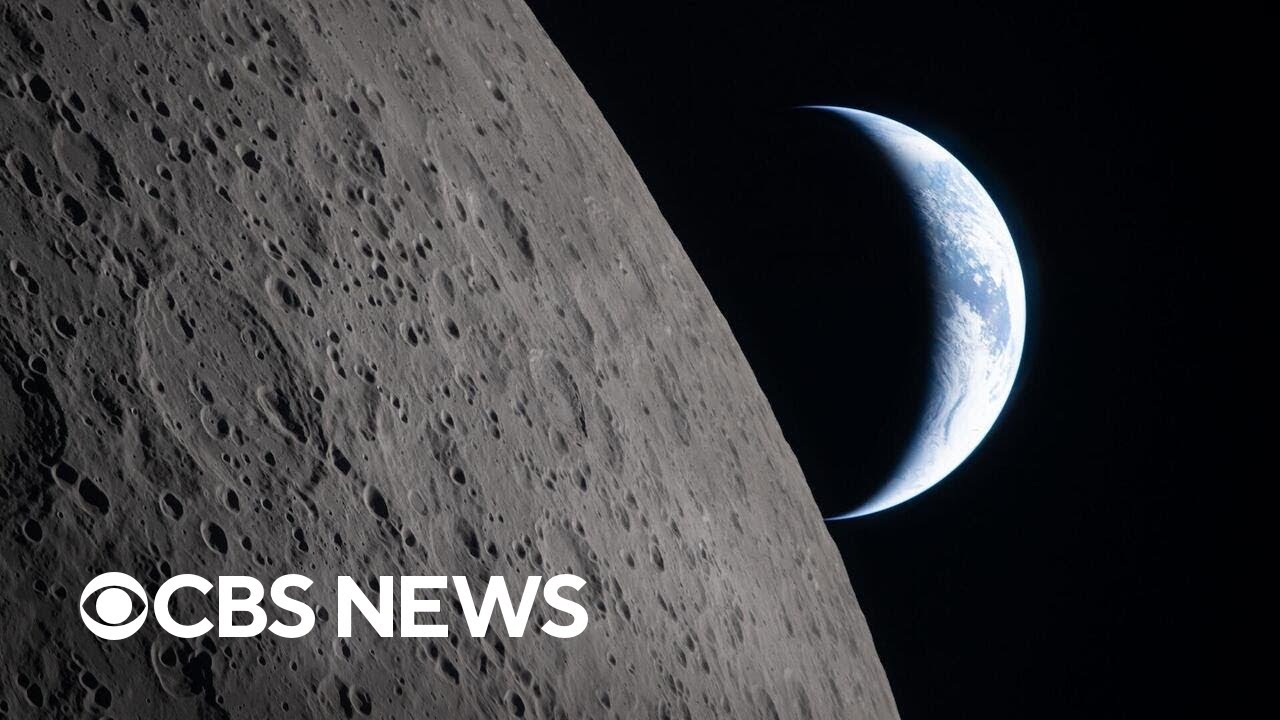
On the moon’s far side, the crew experienced 40 minutes of profound solitude, cut off from all communication with Earth. Their unique vantage point yielded a breathtaking sight: a solar eclipse with Earth silhouetted against the sun, and the haunting view of “Earthset” as their home planet slipped behind the lunar horizon.
“This is the first step towards… going back to the moon to stay,” mission specialist Christina Koch emphasized, underscoring the flight’s role as a proving ground for future lunar landings. The mission also set a new deep-space record, surpassing the distance achieved by Apollo 13 and venturing nearly 249,000 miles from Earth.

The journey home focused all attention on Orion’s heat shield, modified after concerning erosion was observed during Artemis I’s re-entry. Streaking into the atmosphere at 24,000 miles per hour, the capsule endured temperatures half as hot as the sun’s surface during a harrowing six-minute communications blackout.
Flight Director Rick Henfling, overseeing the re-entry, acknowledged the tension of the “unknown unknowns.” The successful splashdown, southwest of San Diego, was met with palpable relief. A dedicated Navy recovery team swiftly secured the capsule and its crew, ending an extraordinary test flight.
Artemis II’s success validates the core systems needed to return humans to deep space. The mission paves the way for Artemis III, which aims to land astronauts near the lunar south pole. NASA is now one giant leap closer to once again leaving human footprints on the dusty lunar surface, with a sustained presence on the moon now firmly in sight.
The four astronauts—Reid Wiseman, Victor Glover, Christina Koch, and Jeremy Hansen—have returned as pioneers, having tested the machine and themselves in the unforgiving environment of deep space. Their odyssey around the moon reopens a highway for humanity to explore beyond Earth orbit, proving that the systems, the teamwork, and the daring required for a lunar future are ready.
Source: YouTube