A single red carpet appearance has ignited a firestorm of online criticism against Meghan, the Duchess of Sussex, with accusations of performative behavior and desperate attention-seeking dominating social media discourse. The event, meant to honor her longtime friend Kelly McKee Ziden, quickly unraveled into a public dissection of Meghan’s every gesture, smile, and fashion choice, set against a backdrop of swirling professional rumors.
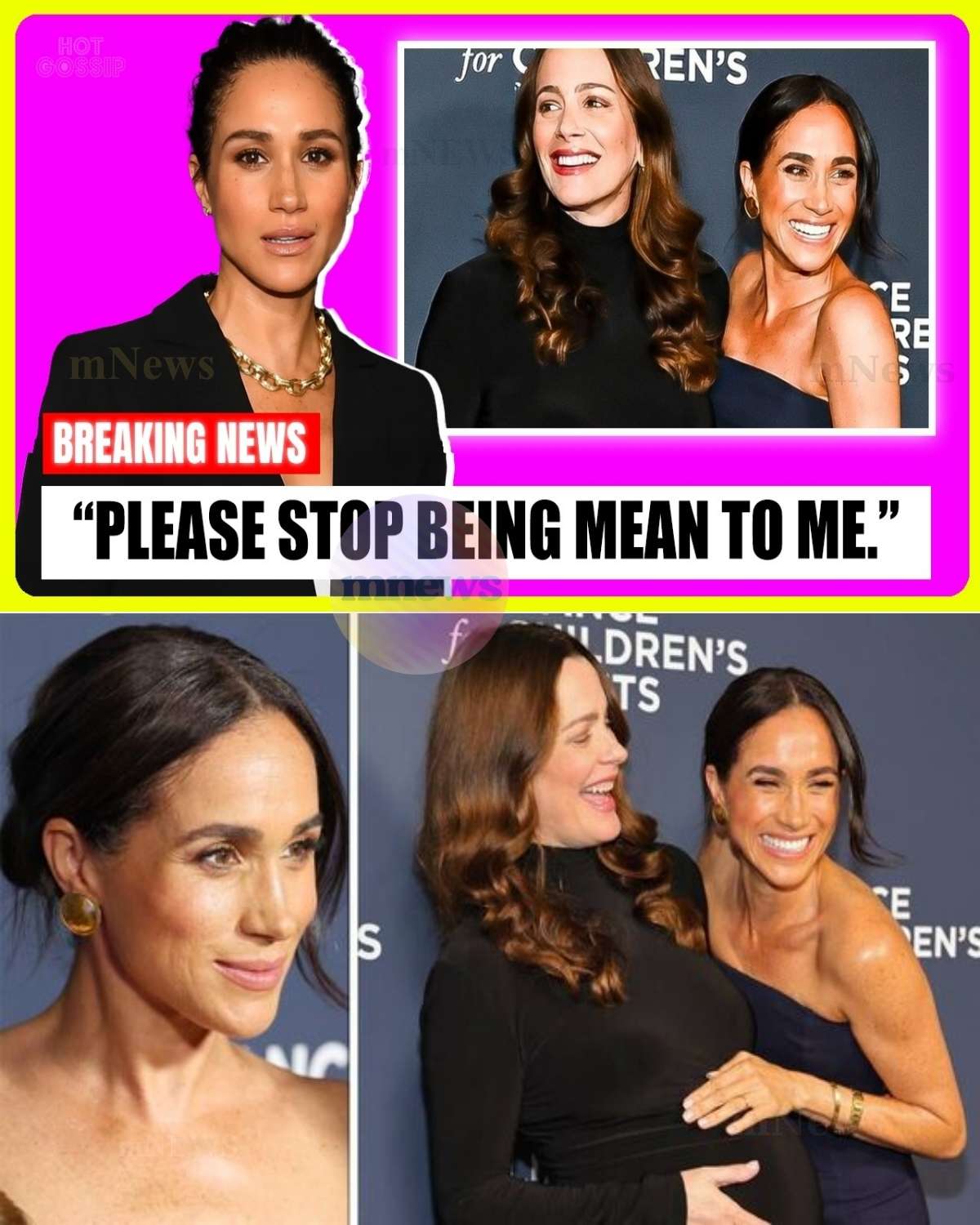
The March 19th appearance at the annual Alliance of Moms gala in Los Angeles began as a glamorous evening. Meghan, presenting an award to her friend and organization co-founder Kelly, wore a sleek white gown valued at thousands. Cameras captured what appeared to be intimate moments between the two women, including Meghan placing her hands on Kelly’s pregnant belly and maintaining close physical contact throughout the event.
Online reaction was swift and merciless. Social media platforms erupted with users labeling her actions as “cringe,” “manic,” and “performative.” Viral commentary dissected her body language, with critics accusing her of dominating her pregnant friend’s moment and appearing “visibly irritated” over photo arrangements. The scrutiny extended to her facial expressions, sparking unfounded cosmetic procedure rumors, and her choice of an expensive designer dress.

A seemingly minor detail—the absence of Meghan’s engagement ring—fueled intense speculation about her personal life, demonstrating how trivial elements can balloon into full-blown narratives in the digital age. Observers immediately connected the dots to recent reports of professional strain, including rumored tensions with Netflix following the couple’s reported multi-million dollar deal’s uncertain future.
This perceived synchronization of personal appearance with corporate narrative led many commentators to frame the entire evening as a calculated publicity move. Critics argued the display was a strategic effort to project an image of loyal friendship and stable personal life, deliberately shifting focus from a series of reported professional setbacks.
The backlash, however, was met with a robust defense from supporters and those familiar with the decades-long friendship between Meghan and Kelly. Defenders argued that the intimacy witnessed was genuine, born from a deep, private bond that has weathered profound personal trials, including significant loss in Kelly’s life.
They contended that public perception has been poisoned by years of biased narrative, causing even authentic gestures of support to be misread as theatrical and self-serving. This defense highlighted the complex duality of life in the spotlight, where sincere emotion is often filtered through the lens of public performance.
The incident serves as a stark case study in modern celebrity culture and the mechanics of viral judgment. Every captured moment—a touch, a glance, a missing piece of jewelry—was extracted, analyzed, and weaponized to fit pre-existing public narratives about the Duchess. The red carpet transformed from a celebratory space into a forensic arena.
Body language experts and amateur analysts alike offered instant interpretations, claiming to decode signals of stress, calculation, or inauthenticity. The conversation spiraled far beyond the event itself, touching on themes of narcissism, celebrity entitlement, and the relentless pressure of maintaining a public image under microscopic examination.
The spectacle underscores a relentless public appetite for drama, particularly surrounding figures who have voluntarily stepped back from traditional royal duties. For Meghan, a woman whose every move has been scrutinized for years, this episode confirms the near-impossibility of a neutral public reception.
Even acts of private loyalty, when exposed on a global stage, become subject to overwhelming interpretation and judgment. The line between a person’s authentic self and their public persona becomes irrevocably blurred, leaving audiences to debate what is real and what is orchestrated.
The fallout from this single evening continues to ripple outward, fueled by endless social media loops and commentary. It reaffirms that for high-profile figures, there is no such thing as a simple, apolitical appearance. Each public moment is a potential flashpoint, a piece of strategic communication whether intended or not.
This event also demonstrates the power of context. The appearance did not occur in a vacuum; it was contextualized by the audience’s knowledge of recent headlines about the couple’s commercial ventures and their ongoing navigation of media relations. This context shaped the interpretation of every smile and gesture.
Ultimately, the controversy speaks less to the specific actions on the carpet and more to the fractured and feverish state of public discourse. It reveals an environment where genuine human interaction is often the first casualty in the rush to assign motive, declare authenticity, and pass judgment.
The narrative is now self-sustaining, with new angles—from the dress cost to an unrelated social media unfollow by a former co-star—constantly feeding the cycle. The story of the evening is no longer about a charity gala or a friendship; it is a meta-commentary on fame, perception, and the digital mob.
As the analysis continues unabated, one central, unresolved question persists for the watching world: in an age where visibility is perpetual and every gesture is commodified, can authenticity ever be convincingly performed, or is it inevitably consumed as just another part of the show? The answer, much like the reaction to Meghan’s red carpet moment, remains fiercely contested.