A determined criminal lawyer turned archaeologist may have solved one of history’s greatest cold cases, bringing the world closer to the lost tomb of Cleopatra VII. Dr. Kathleen Martinez’s decades-long obsession, defying academic skepticism, has led to a monumental underwater discovery off Egypt’s coast that could rewrite the final chapter of the legendary queen’s story.
Martinez’s unconventional theory centered on the temple of Taposiris Magna, dedicated to Osiris, god of the afterlife. She believed Cleopatra, who identified with the goddess Isis, chose this site for her and Mark Antony’s burial. Her relentless excavation uncovered coins bearing Cleopatra’s image and a vast, submerged tunnel system, hinting at a portion of the ancient complex now beneath the Mediterranean.
The critical breakthrough came with the discovery of a foundation plate confirming the temple was indeed dedicated to Isis. This evidence convinced authorities to green-light an underwater search, enlisting Robert Ballard, discoverer of the Titanic. Their survey revealed staggering finds: massive stone blocks and structures standing 6-10 feet tall, remnants of a city lost to the sea for millennia.
These underwater ruins, aligned with the ancient coastline and constructed from the same basalt as the land temple, strongly suggest a deliberate, grand construction. Martinez now posits that Cleopatra’s tomb, intended to be a mirror temple to her beloved Isis, collapsed into the water, preserving it from looters for over two thousand years.
Cleopatra’s final days are shrouded in drama and defeat. After losing the Battle of Actium to Octavian, she and Antony retreated to Alexandria. Facing capture, Antony died by suicide in her arms. Days later, rather than be paraded as a Roman trophy, Cleopatra ended her own life at age 39, leaving her burial place a secret.
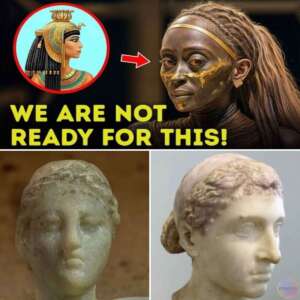
The potential discovery transcends mere treasure hunting. Unsealing Cleopatra’s tomb could provide unparalleled insight into her reign, her political genius, and the turbulent merger of Egyptian and Roman power. It promises to cut through centuries of Roman propaganda that painted her merely as a seductress, revealing the true face of a formidable scholar and strategist.
Martinez’s journey began with a childhood defense of Cleopatra against her father’s casual dismissal. That spark ignited a passion that saw her teach herself archaeology, earn a master’s degree, and move to Egypt with nothing but a theory. Her story is one of extraordinary tenacity, challenging entrenched academic beliefs.
While the underwater site holds immense promise, the work is delicate and ongoing. Archaeologists must meticulously document and potentially excavate the sunken structures, a process that could take years. The world now watches, waiting to see if the Mediterranean will finally yield its most famous royal secret.
This discovery coincides with other revolutionary finds in Egypt, including the recent identification of Pharaoh Thutmose II’s tomb. Together, they underscore how modern technology and persistent inquiry are illuminating ancient shadows, proving that the sands and seas of Egypt still guard stories waiting to be told. The quest for Cleopatra, it seems, has entered its final, breathtaking act.