Nearly two decades after his murder, the specter of The Notorious B.I.G. continues to haunt the public imagination, not through music alone, but through a relentless series of alleged sightings and digital phenomena that challenge the finality of his death. From viral photographs that shut down social media to sophisticated media hoaxes, Christopher Wallace remains perpetually in frame, fueling a conspiracy theory that refuses to die. The world has been convinced time and again that the King of New York never really left, creating a legacy as much about mystery as it is about music.
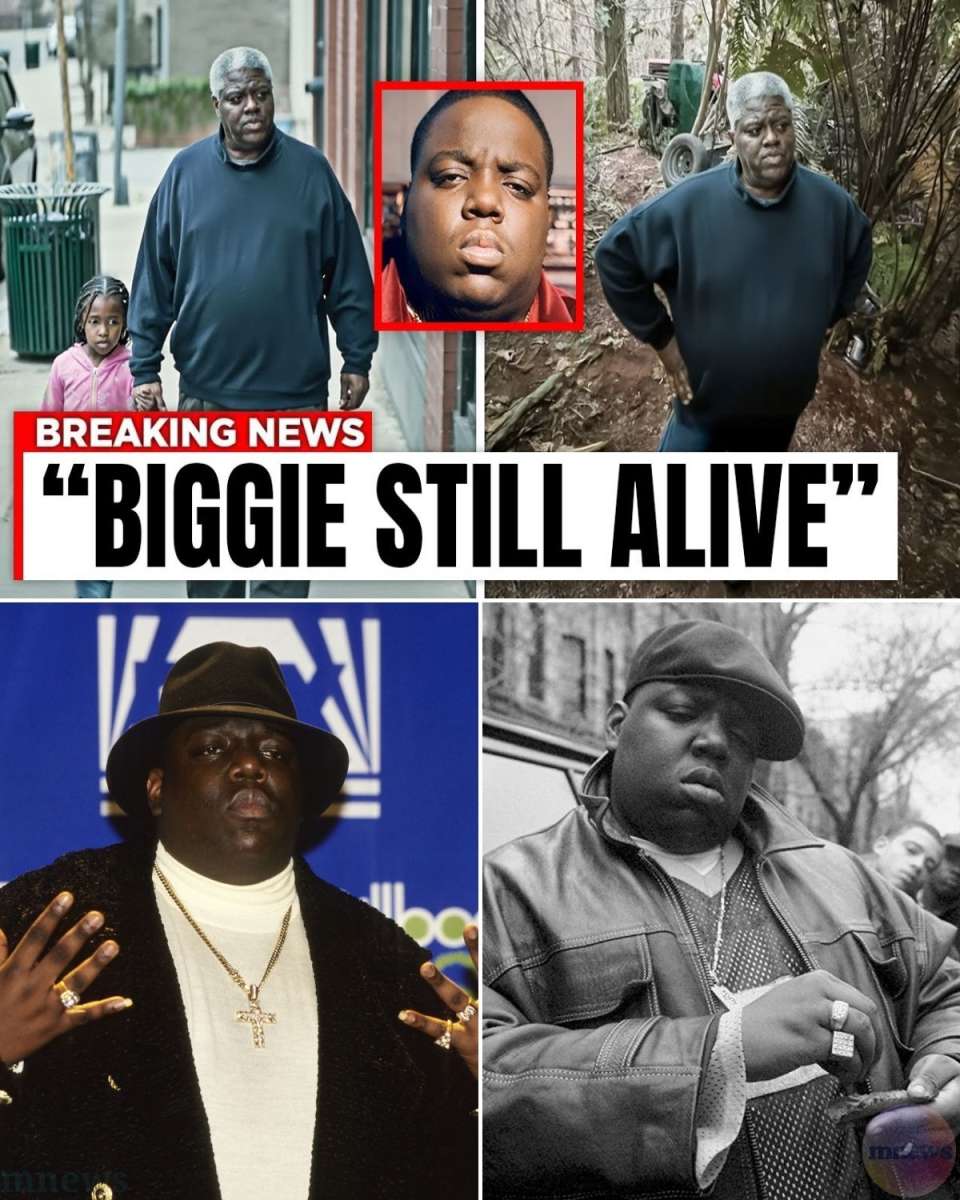
Our journey begins with perhaps the single most viral “Biggie is alive” moment in internet history. In early 2017, a photograph exploded across social media, showing a heavy-set Black man at a festive bachelor party. The resemblance was uncanny—his build, his features, his demeanor triggered a global frenzy among hip-hop fans. The image, posted with the caption “Biggie is alive,” was misattributed to a location in Greece, weaving an exotic narrative of escape.
The truth, however, was a stark lesson in digital-age misinformation. The man was identified as Jordan Anderson, a UK student bearing a striking resemblance to the late rapper. The location was Brighton, England. Despite Anderson confirming his identity and dismissing the comparisons, the photograph persisted in circulation. This incident demonstrated a profound cultural truth: twenty years after his murder, a single lookalike could still generate worldwide conversation and spark genuine hope among devoted fans.
Rewind to 2011, when an audacious technological hoax lent shocking legitimacy to survival claims. The activist collective Anonymous hacked the PBS website, publishing a fabricated news article. The report claimed Tupac Shakur had been discovered living in New Zealand—and that Biggie Smalls was there with him, the former rivals reconciled and living in peaceful obscurity. The PBS domain lent an air of authority that sent the story spreading like wildfire.

Though quickly identified as a political statement about media security, the hoax had already embedded itself in hip-hop lore. It effectively played into a poetic fantasy fans desperately wanted to believe: that the two icons had escaped the violence that defined their feud. The idea of them finding peace together in a remote paradise transformed a story of tragedy into one of redemption, showcasing the enduring power of hope against factual correction.
Another persistent claim emerged from the concert scene around 2010. Through YouTube videos and forum discussions, theorists alleged that Biggie had been spotted in the crowd at an Eminem concert. Sharp-eyed fans analyzed grainy footage, pointing to a man’s size, age, and demeanor as proof. The setting seemed plausible to believers—a way for a surviving Biggie to anonymously witness the evolution of the genre he helped shape.
This sighting, however, remained entirely unverified. No clear photographs emerged, and no one came forward with confirmation. Experts consistently dismissed it as a classic case of pareidolia—the tendency to see meaningful patterns where none exist, amplified by poor lighting and camera angles. Yet, the emotional resonance of the image—Biggie free from danger, simply enjoying the music—ensured its place in the collection of “maybe” moments.
Zooming out reveals a global doppelgänger phenomenon that has persisted for decades. From Jamaica to the United Kingdom, social media continuously delivers photographs of individuals bearing varying resemblance to the legendary rapper. Each new image reignites discussions, with the geographic diversity of sightings itself fueling mythology about potential hiding places. In a world of nearly eight billion people, such resemblances are statistically inevitable.
This phenomenon speaks to Biggie’s distinctive physical presence, making any similarity instantly recognizable. Yet, it consistently overlooks concrete evidence: medical records, autopsy reports, and the profound, documented grief of his family. The continued search for his face in a crowd is a testament to how deeply he affected his audience, turning every lookalike into a vessel for collective longing.
Theories also delve into the artist’s own words, searching his lyrics for cryptic messages. His posthumous album “Life After Death,” released just days after his murder, seemed eerily prophetic. Tracks like “You’re Nobody (Til Somebody Kills You)” led some to speculate the album was a roadmap for his own disappearance, a coded announcement of a planned exit from public life.
Music historians offer a simpler explanation. Death was a consistent theme in Biggie’s art, reflecting the reality of his environment rather than forecasting his fate. When an artist dies young, previous contemplations of mortality naturally take on heavier significance. For dedicated theorists, however, the lyrical analysis continues, treating the album not as a collection of songs but as a potential confession from beyond the grave.
Shifting from speculation to firsthand testimony, the on-camera accounts of Biggie’s bodyguard, Gene Deal, have become crucial footage. Deal has given extensive video interviews describing multiple, serious death threats Biggie received in Los Angeles. He recounts a specific warning from an incarcerated kingpin named Unique, who called explicitly to state there was a hit ordered and Biggie should leave the city immediately.
Perhaps most haunting is Deal’s description of Biggie’s reaction. “Anytime I knew Big was being threatened,” Deal states on camera, “Big was joking.” This captured testimony paints a picture of a man who underestimated the lethal danger around him. While not supporting survival theories, these widely shared clips add layers to the narrative, raising persistent questions about security failures and preventable tragedy.
The most authoritative on-camera investigations come from retired LAPD detective Greg Kading, who led the task force reinvestigating the murders. In documented interviews, Kading outlines an evidence-based methodology, contrasting it with conspiracy theory. “A conspiracy theory starts with a conclusion and then works backwards,” he states. “In an objective investigation, you start with no conclusions, and you just follow the facts.”
Kading’s investigation concluded that Wardell “Poochie” Fouse, a Mob Piru Bloods member, was the shooter, allegedly hired for $13,000 by Suge Knight as revenge for Tupac’s death. Kading explains on camera that prosecution became impossible because the alleged shooters in both murders were already dead by the time confessions were obtained. His direct-to-camera revelations present what he calls definitive conclusions, offering millions of viewers a version of closure.
The legal battle waged by Biggie’s mother, Voletta Wallace, generated its own massive archive of visual documentation. Her wrongful death lawsuit against the City of Los Angeles, alleging police corruption and cover-up, produced thousands of pages of testimony and constant media coverage. Her public frustration, captured in news clips, added a powerful, human dimension to the mystery—a grieving mother demanding answers on camera for the world to see.
Although the case ended in a mistrial and was later dismissed, the footage and filings it produced remain foundational. They fuel both legitimate inquiry and endless speculation, ensuring the institutional response to the murder is as scrutinized as the crime itself. Voletta Wallace’s pursuit of justice became an integral part of the story’s visual record.
Documentary films have further cemented the case in the public eye. Nick Broomfield’s 2002 film “Biggie & Tupac” presented a compelling conspiracy narrative involving Suge Knight and corrupt LAPD officers. Years later, Broomfield revisited the subject with “Last Man Standing,” adding new witnesses and evidence. Competing narratives, like the “Murder Rap” documentary tied to Greg Kading’s findings, present conflicting conclusions.
This cinematic investigation ensures the story is perpetually re-litigated. Each new documentary generates fresh debate, brings new witnesses to the screen, and introduces the mystery to new generations. The cameras have never stopped rolling, making the unsolved murder a permanent fixture in cultural discourse.
Today, social media platforms sustain this perpetual speculation. Every anniversary sparks a flood of memes, threaded analyses, and recycled “evidence.” YouTube channels dissect every clue; Reddit forums host endless debates; interview clips from Gene Deal or Greg Kading are clipped and reshared endlessly. The digital age has created an eternal present for the mystery, where crowdsourced investigation never sleeps.
Recent developments, like the 2023 arrest in Tupac’s case, immediately triggered renewed social media fervor around Biggie’s murder. This digital documentation ensures Christopher Wallace is forever caught in the lens—not as a living man, but as an immortal, unresolved question. His legacy is now a loop of remembrance and conjecture, proving that for an icon of his magnitude, the final curtain never truly falls.